
Fast Websites: Build Speed, Rankings, and Revenue
Website speed determines whether your business thrives or disappears in the competitive digital landscape of 2026. Every additional second your pages take to load drives away potential customers, damages your search rankings, and costs you revenue. Fast websites deliver immediate value to users while signaling quality to search engines and AI platforms that determine your visibility. Understanding how to build and maintain high-performance sites has become essential for businesses that want to compete effectively online.
Why Speed Defines Modern Web Success
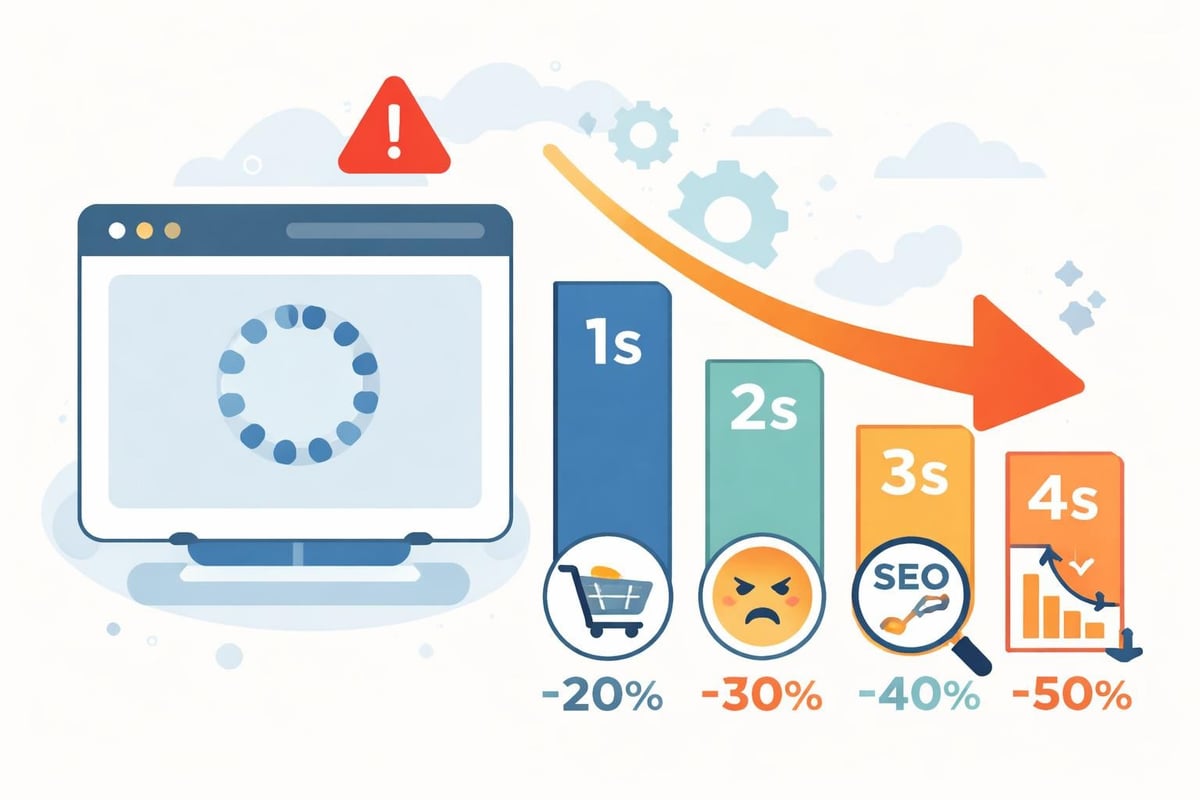
The relationship between loading time and business outcomes has never been more direct. Research consistently shows that users abandon sites that take longer than three seconds to load, and search engines penalize slow-performing pages in their rankings.
Performance impacts multiple critical metrics:
- Conversion rates drop by an average of 4.42% for each additional second of load time
- Bounce rates increase significantly when pages exceed two-second load times
- Search engine rankings factor speed into their core algorithm calculations
- User trust and brand perception suffer when sites feel sluggish
Google and other search platforms have made speed a primary ranking factor because it directly correlates with user satisfaction. When you invest in SEO, performance optimization becomes a fundamental component of your strategy, not an optional enhancement.
The Technical Foundation of Performance
Fast websites emerge from deliberate architectural decisions made during the design and development process. Modern web development frameworks offer built-in performance optimizations, but only when developers configure them correctly and follow best practices for web performance.
The critical rendering path determines how quickly browsers can display content to users. Minimizing render-blocking resources, optimizing CSS delivery, and deferring non-critical JavaScript all contribute to faster perceived performance. Server response times must stay below 200 milliseconds to avoid creating bottlenecks before content even begins loading.
| Performance Factor | Target Metric | Impact Level |
|---|---|---|
| Time to First Byte | < 200ms | Critical |
| First Contentful Paint | < 1.8s | High |
| Largest Contentful Paint | < 2.5s | Critical |
| Total Blocking Time | < 200ms | High |
| Cumulative Layout Shift | < 0.1 | Medium |
Image Optimization Strategies
Images typically account for the majority of page weight on modern websites. Proper image optimization can reduce total page size by 60-80% without noticeable quality loss to users.
Modern image formats like WebP and AVIF provide superior compression compared to traditional JPEG and PNG files. Converting your image library to these formats typically reduces file sizes by 25-35% while maintaining visual quality. Implementing responsive images through the srcset attribute ensures browsers only download appropriately sized versions for each device.
Essential image optimization techniques:
- Compress images to appropriate quality levels (80-85% for JPEG maintains visual quality)
- Implement lazy loading for images below the fold
- Use modern formats with fallbacks for older browsers
- Specify explicit width and height attributes to prevent layout shift
- Serve images through CDNs for faster global delivery
The web performance optimization strategies employed by leading sites demonstrate how systematic image handling improves overall speed metrics significantly.
Content Delivery Networks and Caching
CDNs distribute your content across geographically dispersed servers, reducing the physical distance between users and your data. This geographical optimization can cut load times by 50% or more for international audiences.
Browser caching instructs visitors' devices to store static resources locally, eliminating redundant downloads on subsequent visits. Properly configured cache headers can reduce server requests by 70-80% for returning visitors. Fast websites implement aggressive caching strategies for static assets while maintaining cache-busting mechanisms for updated content.
Code Efficiency and Minification
Bloated code slows down every aspect of website performance. Minification removes unnecessary characters from HTML, CSS, and JavaScript files without changing functionality, typically reducing file sizes by 20-40%.
JavaScript presents particular challenges for performance because browsers must download, parse, and execute it before rendering can complete. Optimizing JavaScript delivery through code splitting, tree shaking, and dynamic imports ensures users only download code needed for the current page.
- Audit your dependencies to identify and remove unused libraries
- Split code into smaller chunks that load on demand
- Minify all production code through automated build processes
- Remove console logs and debugging code from production builds
- Implement differential loading to serve modern code to modern browsers
Third-party scripts represent a common performance bottleneck. Analytics tools, chat widgets, and advertising platforms often add hundreds of kilobytes of JavaScript that blocks rendering. Fast websites carefully evaluate each third-party integration and implement them asynchronously when possible.

Database and Server Optimization
Backend performance directly affects how quickly your server can generate and deliver pages. Database queries that take seconds to execute will always result in slow page loads regardless of frontend optimizations.
Server-side performance strategies include:
- Implementing database query caching for frequently accessed data
- Using connection pooling to reduce database overhead
- Optimizing database indexes for common query patterns
- Implementing server-side caching layers like Redis or Memcached
- Upgrading to faster hosting infrastructure when necessary
The hosting environment fundamentally determines baseline performance capabilities. Shared hosting platforms often struggle to deliver the response times needed for truly fast websites, while dedicated or cloud-based solutions provide more consistent performance under varying traffic loads.
Mobile Performance Considerations
Mobile devices dominate web traffic in 2026, yet they typically have slower processors and network connections than desktop computers. Optimizing for mobile performance requires specific strategies beyond desktop optimization.
Network conditions on mobile devices vary dramatically based on location and carrier. Implementing adaptive loading strategies that detect connection speed and adjust resource delivery accordingly helps maintain acceptable performance across diverse conditions. Progressive web app techniques enable offline functionality and instant subsequent loads.
| Mobile Optimization | Implementation | Benefit |
|---|---|---|
| Responsive Images | srcset attributes | 40-60% bandwidth savings |
| Touch Target Sizing | Min 44x44px buttons | Improved usability scores |
| Network Adaptation | Connection-aware loading | Better slow connection experience |
| Service Workers | Offline caching | Instant repeat visits |
Modern web design practices prioritize mobile performance from the initial design phase rather than treating it as an afterthought. Mobile-first design naturally creates faster experiences because it forces developers to prioritize essential content and functionality.
Monitoring and Continuous Improvement
Building fast websites represents only the starting point. Performance degrades over time as new features, content, and integrations accumulate. Establishing continuous monitoring systems helps identify performance regressions before they impact users.
Google PageSpeed Insights, Lighthouse, and WebPageTest provide detailed performance analysis with specific optimization recommendations. These tools measure real-world performance metrics and compare your site against established benchmarks. The practical optimization approaches demonstrated in recent case studies show how systematic testing drives measurable improvements.
Real user monitoring (RUM) captures actual performance data from your visitors rather than synthetic tests. RUM reveals how different devices, networks, and geographic locations experience your site, highlighting optimization opportunities that lab tests might miss.
Core Web Vitals and Search Rankings
Google's Core Web Vitals framework establishes specific performance thresholds that impact search rankings. These metrics measure loading performance, interactivity, and visual stability from real user perspectives.
The three Core Web Vitals metrics are:
- Largest Contentful Paint (LCP): Measures loading performance (target: 2.5 seconds or faster)
- First Input Delay (FID): Measures interactivity (target: 100 milliseconds or less)
- Cumulative Layout Shift (CLS): Measures visual stability (target: 0.1 or less)
Meeting these thresholds doesn't guarantee top rankings, but failing to meet them creates a significant disadvantage against competitors who prioritize performance. Search algorithms in 2026 increasingly factor user experience signals into ranking decisions, making speed optimization inseparable from SEO success.
AI-powered search platforms like ChatGPT and Perplexity also consider performance when determining which sources to cite and recommend. Sites that load quickly and deliver information efficiently earn preferential treatment in AI search results, making speed optimization essential for visibility across all search channels.
Conversion Rate Optimization Through Speed
Performance directly drives conversion rates across all industries and business models. E-commerce sites see particularly dramatic impacts, with studies showing that a one-second improvement in load time can increase conversions by up to 7%.
The psychological perception of speed matters as much as actual load times. Implementing skeleton screens, progressive loading, and optimistic UI updates creates the impression of instant responsiveness even while background processes complete. Users perceive sites as faster when they receive immediate visual feedback, even if total load time remains unchanged.

Shopping cart abandonment correlates strongly with page speed during checkout flows. Each additional second of delay during payment processing increases abandonment rates significantly. Fast websites maintain momentum through the entire conversion funnel, reducing friction at each decision point.
Framework and Platform Selection
The technology stack you choose fundamentally determines performance potential. Some frameworks and content management systems create inherent performance limitations that require extensive optimization to overcome.
Static site generators produce the fastest possible websites by pre-rendering pages at build time rather than generating them on each request. Platforms like Next.js, Gatsby, and Astro deliver exceptional performance while maintaining developer productivity and flexibility. When building modern websites designed to rank, selecting the right foundation eliminates entire categories of performance problems.
Traditional content management systems like WordPress can achieve good performance through careful optimization and caching strategies. However, they require more active maintenance and monitoring to prevent performance degradation as plugins and customizations accumulate over time.
Platform performance comparison:
| Platform Type | Baseline Performance | Optimization Effort | Maintenance Requirements |
|---|---|---|---|
| Static Site Generators | Excellent | Low | Low |
| Headless CMS | Very Good | Medium | Medium |
| Traditional CMS | Fair to Good | High | High |
| Custom Applications | Variable | Variable | High |
Advanced Performance Techniques
Leading fast websites implement sophisticated optimization strategies that go beyond basic best practices. HTTP/2 and HTTP/3 protocols enable multiplexed connections and server push capabilities that reduce network overhead. Implementing these protocols requires server configuration changes but delivers measurable performance improvements.
Resource hints like preconnect, prefetch, and preload tell browsers to begin loading critical resources before they're explicitly requested. Strategic use of these hints can reduce perceived load times by initiating network requests during idle time.
Edge computing pushes computation and content delivery to servers physically close to users. Platforms like Cloudflare Workers and Vercel Edge Functions execute code at edge locations worldwide, reducing latency for dynamic content generation. This geographical distribution becomes increasingly important as global audiences grow.
Progressive enhancement ensures fast websites remain functional even when advanced features fail to load. Building core functionality with standard HTML and CSS, then layering enhanced experiences through JavaScript, creates resilient sites that work everywhere while performing optimally on modern devices.
Real-World Performance Case Studies
Examining documented performance improvements from actual implementations provides concrete evidence of optimization impact. One developer reduced their site's load time from 4.2 seconds to 0.8 seconds through systematic image optimization, code splitting, and caching implementation, resulting in a 156% increase in organic traffic over three months.
E-commerce platforms consistently demonstrate the revenue impact of speed optimization. Major retailers report that each 100-millisecond improvement in load time increases conversion rates by 1%, translating directly to millions in additional revenue for high-traffic sites.
The relationship between site speed and business outcomes extends beyond immediate conversions to long-term customer relationships. Users who experience fast, responsive sites develop stronger brand affinity and return more frequently than those frustrated by slow performance.
Balancing Features and Performance
Fast websites don't sacrifice functionality for speed. Instead, they implement features strategically and load them efficiently. Every addition to a site carries a performance cost that must be justified by user value.
The 80/20 rule applies to web features: 80% of users typically utilize only 20% of available functionality. Identifying and optimizing this critical 20% while lazy-loading or deferring secondary features maintains both rich functionality and excellent performance.
Feature implementation strategies:
- Implement core functionality with minimal dependencies
- Load advanced features only when users actively engage with them
- Use intersection observers to load components as they enter the viewport
- Implement feature flags to test performance impact before full deployment
- Regularly audit feature usage to identify and remove unused code
Animation and visual effects enhance user experience when implemented efficiently. CSS animations perform significantly better than JavaScript-based alternatives because browsers can optimize them at the rendering layer. Choosing the right animation approach prevents visual enhancements from degrading performance.
Building fast websites requires technical expertise, systematic optimization, and ongoing monitoring to maintain performance as your digital presence evolves. The direct connection between speed and business success makes performance optimization a strategic priority rather than a technical detail. Creotivity specializes in building high-performance websites optimized for both traditional search engines and AI platforms, combining speed optimization with strategic design to help businesses attract and convert more customers. Ready to transform your online presence with a site that loads instantly and ranks consistently? Let's build something exceptional together.