Rank on AI: The Complete Guide for 2026
The search landscape has fundamentally changed. While traditional Google rankings still matter, AI-powered search engines like ChatGPT, Perplexity, Claude, and Google AI Overviews are now delivering answers directly to users without requiring them to click through to websites. The ability to rank on AI platforms has become essential for businesses that want to remain visible to their target audiences. Understanding how AI systems select, cite, and recommend brands requires a completely different approach than traditional search engine optimization.
Understanding AI Search Rankings
AI search engines operate fundamentally differently than traditional search platforms. When users ask ChatGPT or Perplexity a question, these systems don't simply return a list of blue links. Instead, they synthesize information from multiple sources and present a comprehensive answer, often citing only a handful of authoritative sources.
The core factors that influence AI citations include:
- Domain authority and trustworthiness
- Content depth and comprehensiveness
- Structured data and semantic clarity
- Citation frequency in training data
- Recency and temporal relevance
Unlike traditional SEO where you can track specific keyword positions, the ability to rank on AI requires monitoring whether your brand appears in AI-generated responses across hundreds or thousands of potential queries. This complexity has led to the emergence of specialized tracking tools designed specifically for AI ranking visibility.
How AI Systems Select Sources
AI language models don't crawl the web in real-time for most queries. Instead, they rely on training data combined with real-time retrieval augmented generation (RAG) systems. The selection process involves multiple layers of filtering and ranking that assess content quality, relevance, and authority.
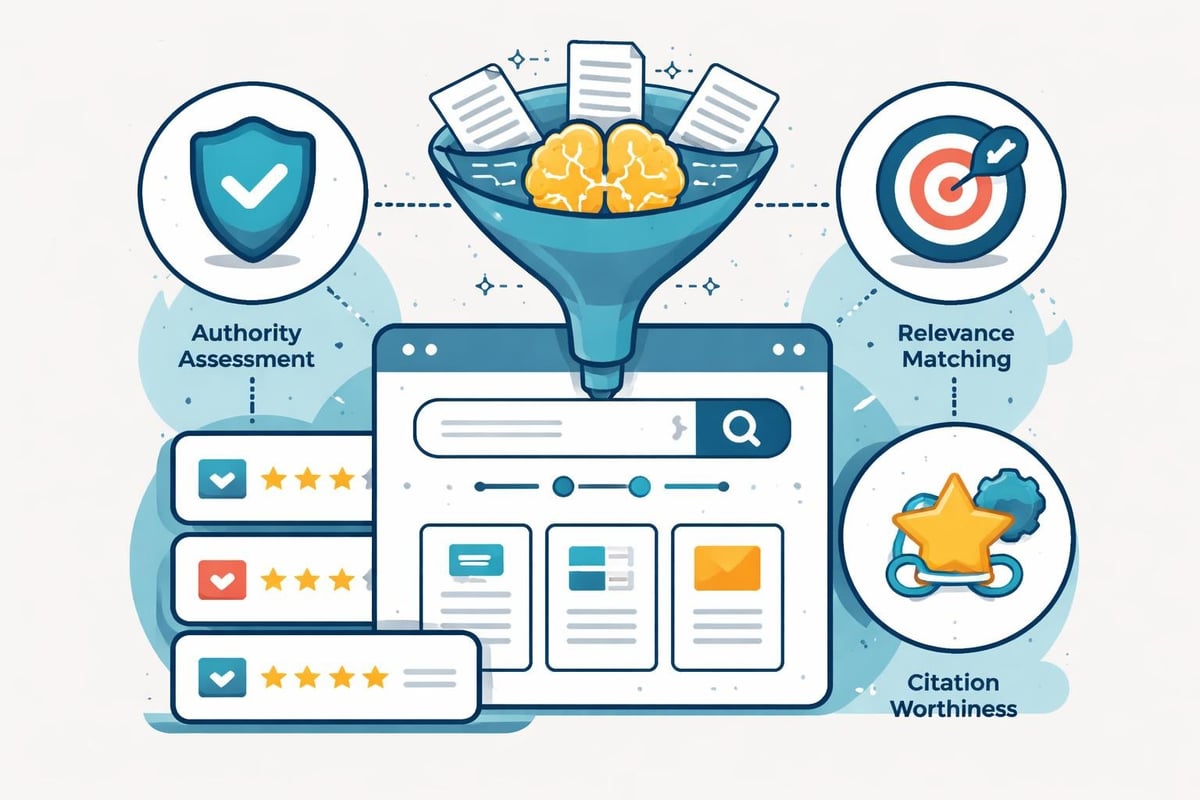
The AI Authority Rank metric has emerged as a standardized way to predict citation likelihood. This metric combines brand mention frequency, content quality signals, and domain trust factors to estimate how often AI systems will reference your business when answering relevant queries.
| AI Platform | Primary Ranking Factors | Citation Style |
|---|---|---|
| ChatGPT | Training data frequency, domain authority, content depth | Inline citations with source links |
| Perplexity | Real-time web retrieval, freshness, semantic relevance | Numbered references with snippets |
| Google AI Overviews | E-E-A-T signals, structured data, traditional SEO factors | Featured content blocks |
| Claude | Constitutional AI alignment, source credibility, comprehensiveness | Contextual attributions |
Strategies to Rank on AI Platforms
Successfully appearing in AI-generated responses requires a multi-faceted approach that goes beyond traditional SEO tactics. The foundation starts with creating content that AI systems recognize as authoritative and comprehensive.
Build Topical Authority
AI systems favor sources that demonstrate deep expertise in specific subject areas. Rather than creating shallow content across many topics, concentrate your efforts on becoming the definitive resource in your niche.
Steps to establish topical authority:
- Identify your core expertise areas where you can provide unique insights
- Create comprehensive pillar content that covers topics exhaustively
- Develop supporting content clusters that explore subtopics in detail
- Maintain consistency in terminology and positioning across all content
- Update existing content regularly to reflect current information
The depth and interconnectedness of your content signal to AI systems that your domain is a reliable source for specific topics. This approach aligns with how businesses optimize for AI visibility while maintaining traditional search rankings.
Optimize for Entity Recognition
AI systems understand content through entities-the people, places, organizations, and concepts mentioned in your text. Proper entity optimization helps AI platforms understand who you are and what you do.
Use schema markup to explicitly define your business entities, products, and services. Consistent NAP (Name, Address, Phone) information across the web reinforces your entity identity. Include relevant entities in your content naturally, linking to authoritative sources when referencing industry concepts or complementary businesses.
Tracking Your AI Rankings
You cannot improve what you don't measure. Traditional rank tracking tools don't capture AI search visibility, necessitating specialized platforms designed for this purpose. Understanding how AI rank trackers work provides the foundation for effective monitoring.
Essential Metrics to Monitor
The ability to rank on AI requires tracking multiple dimensions of visibility across different platforms and query types.
- Citation frequency: How often your brand appears in AI responses
- Position in citations: Whether you're the primary source or a supporting reference
- Query coverage: The breadth of topics where you receive mentions
- Platform distribution: Your presence across ChatGPT, Perplexy, Claude, and others
- Competitive displacement: Instances where you replace competitor citations
Tools like Rank High on AI provide comprehensive tracking across multiple AI platforms, offering keyword-level reports that show exactly which queries generate brand mentions. This granular data enables you to identify content gaps and optimization opportunities.

Setting Realistic Benchmarks
Unlike traditional search where position one is the clear goal, AI rankings operate on a spectrum of visibility. Being cited alongside two other sources in a Perplexity response represents success, even if you're not the sole reference.
| Visibility Level | Definition | Typical Citation Rate |
|---|---|---|
| Dominant | Primary or sole source cited | 60-100% of relevant queries |
| Strong | Frequently cited among top 3 sources | 30-60% of relevant queries |
| Emerging | Occasional citations in competitive spaces | 10-30% of relevant queries |
| Minimal | Rare mentions or niche query citations | Below 10% of relevant queries |
Content Optimization for AI Search
Creating content that ranks on AI platforms requires specific structural and stylistic choices that make information easily extractable and attributable.
Structure for Information Extraction
AI systems excel at extracting well-organized information. Structure your content to facilitate this process through clear hierarchies, direct answers, and logical flow.
Start major sections with clear definitions or direct answers to common questions. Use descriptive headings that contain the actual questions or topics being addressed. Break complex information into digestible chunks with bullet points, numbered lists, and tables that AI can easily parse and cite.
The formatting choices that help traditional SEO performance also benefit AI visibility, but the emphasis shifts toward information density and clarity over keyword density.
Write with Attribution Clarity
AI systems need to understand the source and credibility of information. Include clear attribution for claims, statistics, and expert opinions within your content. When stating facts, provide context about methodology or data sources.
Best practices for attribution clarity include:
- Dating your content explicitly with publication and update timestamps
- Identifying author credentials and expertise for bylined pieces
- Citing original research or data sources for statistics
- Using first-person perspective for unique insights and experiences
- Linking to authoritative sources that support your claims
This transparency not only helps AI systems verify information but also builds trust with human readers who increasingly value source credibility. Resources like Ahrefs' guide to ranking in AI Overviews provide data-driven insights into what content characteristics correlate with AI citations.
Technical Foundation for AI Visibility
The technical infrastructure of your website directly impacts whether AI systems can access, understand, and cite your content. While AI platforms don't rely on traditional crawling in the same way as Google, technical optimization remains critical.
Schema and Structured Data
Implement comprehensive schema markup that explicitly defines your content's meaning and context. Organization schema, Article schema, FAQPage schema, and product markup all help AI systems understand what information your pages contain.
| Schema Type | AI Benefit | Implementation Priority |
|---|---|---|
| Organization | Establishes entity identity and authority | Critical |
| Article | Provides publication metadata and authorship | High |
| FAQPage | Surfaces question-answer pairs for direct extraction | High |
| HowTo | Enables process extraction for instructional content | Medium |
| Product | Facilitates product comparison and recommendation | Medium |
| Review | Supports credibility signals through aggregated ratings | Low-Medium |
Performance and Accessibility
AI systems that perform real-time retrieval need fast, accessible websites. Page speed, mobile optimization, and clean HTML structure all contribute to whether your content gets included in AI training data and real-time responses.
Ensure your robots.txt doesn't block important AI crawlers. While ChatGPT's crawler is well-known, other AI platforms use various user agents that should have appropriate access to your content. Monitor your server logs to identify AI bot traffic and ensure these requests receive appropriate responses.
Advanced AI Optimization Techniques
Beyond foundational strategies, sophisticated approaches can significantly increase your ability to rank on AI platforms consistently.
Question-Answer Content Architecture
Structure significant portions of your content around explicit questions and comprehensive answers. This format directly aligns with how users query AI systems and how those systems extract information for responses.
Create dedicated FAQ sections that address common questions in your industry. Develop long-form content that answers complex questions with depth and nuance. Use natural language that mirrors how real people ask questions, not just how they type keywords into search boxes.
Conversation Context Optimization
AI systems excel at maintaining conversational context. Create content that addresses follow-up questions and related topics that naturally emerge from initial queries. This approach increases the likelihood that your content appears in multi-turn AI conversations.
When someone asks ChatGPT about a topic and then asks a follow-up question, the AI needs sources that address both the initial query and the natural progression of inquiry. Content that anticipates these conversational pathways gains citation advantages.
Leveraging AI for Content Creation
Tools like Frase help create content optimized for both traditional search and AI platforms. These platforms analyze top-performing content, identify semantic gaps, and suggest structural improvements that increase citation likelihood.
However, purely AI-generated content often lacks the unique insights and firsthand expertise that distinguish highly-cited sources. The most effective approach combines AI efficiency with human expertise, creating comprehensive content that provides genuine value beyond synthesized information.
Competitive Analysis for AI Rankings
Understanding your competitive landscape in AI search requires different tools and approaches than traditional SEO competitive analysis.
Identifying Your AI Competitors
Your competitors for AI rankings may differ from your traditional SEO competitors. AI systems cite authoritative sources regardless of commercial intent, meaning academic institutions, government agencies, and industry publications may compete for citations in your space.
Use tools that check AI rankings to identify which sources AI platforms cite for your target queries. Analyze their content structure, depth, and authority signals to understand what makes them citation-worthy.
Key elements to analyze in competitor content:
- Content comprehensiveness and depth of coverage
- Use of structured data and semantic markup
- Author credentials and expertise signals
- Frequency of content updates and freshness
- External citations and authoritative backlinks
Gap Analysis and Opportunity Identification
Identify queries where competitors consistently receive citations but your brand doesn't appear. These represent immediate optimization opportunities where you can create or enhance content to compete for AI visibility.
Look for topics where current AI responses lack depth or provide outdated information. Creating the definitive, current resource on these topics positions you as the obvious citation choice when AI systems encounter related queries.
Integration with Overall Digital Strategy
The ability to rank on AI shouldn't exist in isolation from your broader digital marketing strategy. AI optimization amplifies traditional SEO efforts while opening new visibility channels.
Synergy with Traditional SEO
Content optimized for AI citations typically performs well in traditional search results. The comprehensiveness, structure, and authority signals that AI systems value align closely with Google's E-E-A-T guidelines and quality standards.
This synergy means investments in AI optimization deliver compounding returns across multiple search channels. Modern web design approaches recognize this convergence, building sites that serve both traditional crawlers and AI systems effectively.
Brand Building Through AI Presence
Consistent citations in AI responses build brand awareness and establish thought leadership. When your business regularly appears as the authoritative source in ChatGPT or Perplexity responses, it reinforces your market position and expertise.
This brand-building effect extends beyond direct traffic. Users who encounter your brand through AI citations develop awareness and trust that influences future purchasing decisions, even if they don't immediately visit your website.
Common Mistakes to Avoid
Many businesses approach AI optimization with misconceptions that undermine their efforts. Avoiding these common pitfalls accelerates your path to consistent AI visibility.
Over-Optimization and Keyword Stuffing
AI systems are sophisticated enough to recognize unnatural language and keyword manipulation. Content that prioritizes keywords over clarity and value rarely receives citations. Focus on comprehensive, natural coverage of topics rather than forcing specific phrases.
Neglecting Update Cycles
Stale content loses citation opportunities to fresher alternatives. AI systems, particularly those with real-time retrieval capabilities, favor current information. Establish regular content review and update cycles that keep your resources current and comprehensive.
Ignoring Platform Differences
Different AI platforms have different strengths, user bases, and citation patterns. ChatGPT, Perplexity, Claude, and Google AI Overviews each operate differently. Content optimized only for one platform may underperform on others. Develop strategies that work across multiple AI systems while recognizing platform-specific opportunities.
Failing to Monitor Results
Without consistent tracking, you can't identify what works and what doesn't. Implement comprehensive AI ranking monitoring from the start, establishing baselines and tracking progress over time. This data-driven approach enables continuous refinement of your strategy.
The ability to rank on AI represents a fundamental shift in how businesses achieve online visibility. By understanding how AI systems select sources, optimizing content for information extraction, implementing proper technical foundations, and continuously monitoring results, you can establish your brand as an authoritative source across AI platforms. As search continues evolving toward AI-driven answers, early adopters gain sustainable competitive advantages that compound over time. Creotivity specializes in building websites and content strategies optimized for both traditional search engines and AI platforms, helping businesses maintain visibility across the entire modern search landscape. Ready to improve your AI rankings and future-proof your digital presence?