
Web Design for Business: A Complete Guide (2026)
Your website serves as the foundation of your digital presence, often determining whether potential customers trust your business enough to make contact. In 2026, effective web design for business extends far beyond aesthetics, incorporating conversion optimization, search engine visibility, and compatibility with AI-powered search platforms. The businesses that thrive understand that their website must work as a 24/7 sales tool, adapting to evolving user expectations and technological advances while maintaining focus on measurable results.
The Business Case for Strategic Web Design
Web design for business represents a critical investment that directly impacts your bottom line. Companies that prioritize strategic design see measurable improvements in conversion rates, customer acquisition costs, and overall revenue growth.
Quantifying the Return on Design Investment
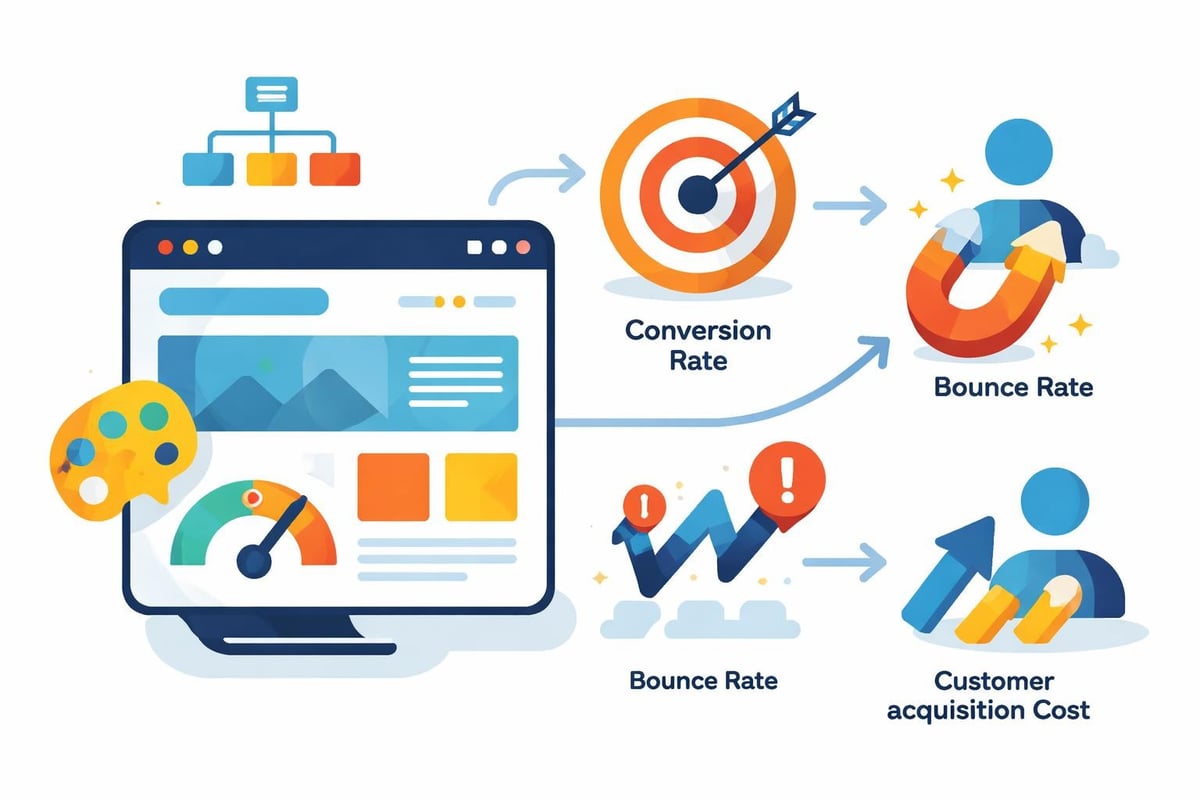
Modern businesses can track specific metrics that demonstrate design effectiveness. Conversion rate optimization through improved layout and user experience typically yields returns of 200-400% within the first year. Page load time improvements of just one second can increase conversions by up to 7%, while mobile-optimized designs capture the 60% of web traffic now originating from smartphones.
Key performance indicators for business websites include:
- Conversion rate (percentage of visitors who complete desired actions)
- Bounce rate (visitors who leave without interaction)
- Average session duration (time spent on site)
- Pages per session (depth of engagement)
- Form completion rates
- Customer acquisition cost per channel
The relationship between design quality and business outcomes becomes clear when examining these metrics. A well-structured site with intuitive navigation and clear calls-to-action consistently outperforms competitors with cluttered or outdated designs.
Essential Elements of Business-Focused Web Design
Successful web design for business balances multiple objectives simultaneously. Your site must attract visitors, communicate value quickly, build credibility, and guide users toward conversion actions.
Navigation Architecture That Drives Results
Navigation serves as the roadmap for your digital presence. Simple, intuitive navigation patterns reduce friction and help visitors find relevant information without frustration. Businesses should limit primary navigation to 5-7 main categories, using descriptive labels that match how customers think about your services.
Sticky navigation bars that remain visible as users scroll provide constant access to key pages and conversion points. Mega menus work well for businesses with extensive product catalogs, while simplified dropdown menus suit service-based companies.
| Navigation Type | Best For | Key Benefit |
|---|---|---|
| Horizontal Menu | Most businesses | Familiar, easy to scan |
| Mega Menu | E-commerce, large catalogs | Displays many options at once |
| Hamburger Menu | Mobile-first designs | Saves screen space |
| Sticky Header | All business types | Constant access to conversion points |
Visual Hierarchy and Content Strategy
Your homepage must communicate value within three seconds. Visual hierarchy directs attention to the most important elements first, using size, color, contrast, and positioning strategically. Headlines should articulate your core value proposition immediately, followed by supporting copy that addresses specific customer pain points.
The strategic use of white space enhances readability and draws focus to key elements. Cramming too much information onto a page overwhelms visitors and dilutes your message. Modern web design for business embraces clean layouts that prioritize clarity over density.
Effective content hierarchy follows this structure:
- Primary headline stating your main value proposition
- Secondary headline or brief supporting statement
- Visual element (image, video, or graphic) reinforcing your message
- Key benefits or differentiators (typically 3-4 points)
- Clear call-to-action with contrasting design
- Trust indicators (testimonials, logos, certifications)
Conversion Optimization Through Design
Every design decision should support your conversion goals. Whether you want visitors to request quotes, schedule consultations, or make purchases, your site's structure must remove obstacles and create clear pathways to action.
Strategic Call-to-Action Placement
High-converting websites position calls-to-action at multiple strategic points throughout the user journey. Above-the-fold placement captures immediate interest, while additional CTAs throughout the page accommodate different decision-making speeds.
Button design significantly impacts click-through rates. Contrasting colors that stand out from your overall palette draw attention without clashing. Action-oriented copy ("Get Your Free Audit" rather than "Submit") increases engagement by 30-40%.
Businesses should test different CTA variations to determine what resonates with their specific audience. A/B testing reveals preferences that often contradict conventional wisdom, making data-driven optimization essential.
Form Design That Converts
Contact forms represent critical conversion points but often create unnecessary friction. Reducing form fields from 11 to 4 can increase conversions by up to 120%. Request only information essential for your immediate business purpose, collecting additional details during follow-up interactions.
Multi-step forms improve completion rates for longer processes by breaking information collection into manageable chunks. Progress indicators reduce abandonment by showing users how close they are to completion.

Technical Performance and SEO Integration
Web design for business must account for both human visitors and search engine algorithms. Technical excellence creates the foundation for visibility while ensuring positive user experiences that support conversion goals.
Page Speed as a Competitive Advantage
Site speed directly affects both search rankings and user satisfaction. Google prioritizes fast-loading sites in search results, while users abandon pages that take longer than three seconds to load. Optimization techniques include image compression, browser caching, content delivery networks, and minimizing JavaScript execution.
Modern businesses should target load times under two seconds for optimal performance. This requires ongoing monitoring and optimization as content evolves and traffic patterns change.
Technical optimization priorities:
- Compress and properly format images (WebP format recommended)
- Minimize HTTP requests through file consolidation
- Implement lazy loading for below-the-fold content
- Use browser caching to store static resources
- Minimize CSS and JavaScript files
- Choose high-performance hosting infrastructure
Mobile Responsiveness as Standard Practice
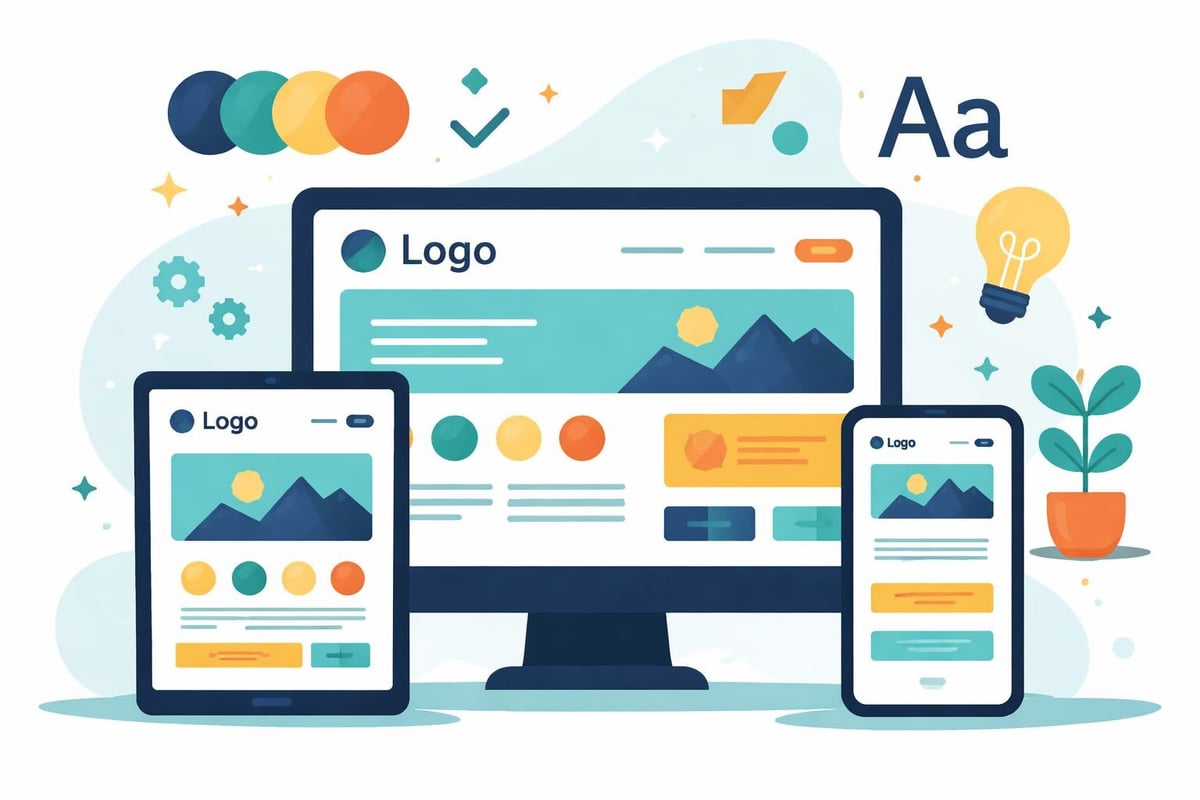
With mobile traffic dominating web usage, responsive design has evolved from optional to mandatory. Google's mobile-first indexing means the mobile version of your site determines search rankings, making mobile optimization a business priority rather than a technical consideration.
Responsive frameworks adapt layouts automatically across devices, but truly effective mobile design considers the distinct contexts of mobile usage. Touch-friendly buttons, simplified navigation, and click-to-call functionality address mobile-specific user needs.
The design of web has fundamentally shifted to prioritize mobile experiences, with desktop layouts often serving as expansions of mobile designs rather than vice versa.
Designing for AI and Modern Search Visibility
The emergence of AI-powered search platforms requires businesses to think beyond traditional SEO. Web design for business in 2026 must account for how AI systems interpret, summarize, and recommend content.
Structured Data and Semantic Markup
AI systems rely heavily on structured data to understand page content and context. Schema markup helps search engines and AI platforms accurately categorize your business, services, products, and content. Implementing organization schema, service schema, and FAQ schema increases the likelihood of appearing in AI-generated responses.
Semantic HTML creates clear content hierarchies that both humans and machines can parse effectively. Proper heading tags (H1, H2, H3) organize information logically, while descriptive link text and alt attributes provide context that AI systems use when generating summaries.
Content Structured for AI Interpretation
AI systems prioritize clear, well-organized content that directly answers user questions. Businesses should structure information using question-and-answer formats, bulleted lists, and tables that AI can easily extract and reformat. Agencies specializing in AI visibility help businesses optimize their digital presence for platforms like ChatGPT, Claude, and Perplexity, ensuring brand visibility as search behavior evolves.
| Traditional SEO Focus | AI Optimization Focus |
|---|---|
| Keyword density | Natural language and context |
| Backlink quantity | Content authority and expertise |
| Meta descriptions | Comprehensive, structured answers |
| Desktop experience | Multi-device consistency |
| Page-level optimization | Site-wide topical authority |
Branding Integration and Visual Identity
Consistent branding throughout your website builds recognition and trust. Web design for business should reflect your brand identity while maintaining usability and conversion focus.
Color Psychology and Brand Perception
Color choices influence perception at a subconscious level, affecting how visitors perceive your professionalism, trustworthiness, and industry positioning. Financial services often use blue to convey stability and trust, while creative agencies employ bold color combinations to demonstrate innovation.
Consistency across all brand touchpoints reinforces recognition. Your website's color palette should align with other marketing materials, creating a cohesive brand experience that builds familiarity over time.
Typography and Readability
Font selection impacts both aesthetics and functionality. Display fonts work well for headlines but reduce readability in body text. Sans-serif fonts generally perform better for web content, offering clarity across different screen sizes and resolutions.
Line length, spacing, and contrast all contribute to readability. Optimal line length ranges from 50-75 characters, while adequate line spacing (1.5x to 2x font size) prevents text from appearing cramped. Sufficient contrast between text and background ensures accessibility across different viewing conditions.
Typography best practices include:
- Maximum of 2-3 font families per site
- Font sizes of at least 16px for body text
- Adequate contrast ratios (4.5:1 minimum for normal text)
- Consistent heading hierarchy
- Appropriate line heights for readability
User Experience and Behavioral Psychology
Understanding how visitors interact with websites enables design decisions that guide users toward desired actions. Web design for business applies behavioral psychology principles to create intuitive experiences that feel natural rather than manipulative.
The F-Pattern and Z-Pattern Scanning
Eye-tracking studies reveal predictable patterns in how users scan web pages. The F-pattern applies to text-heavy pages, with users scanning horizontally across the top, down the left side, and across again further down. The Z-pattern suits pages with minimal text, following a path from top-left to top-right, diagonally to bottom-left, then across to bottom-right.
Positioning key elements along these natural scanning paths increases their visibility without requiring users to search actively. Calls-to-action placed at the end of Z-pattern flows capitalize on the natural conclusion of the visual journey.
Trust Signals and Social Proof
Credibility indicators reduce the perceived risk of engaging with your business. Client logos, testimonials, case studies, industry certifications, and security badges all serve as trust signals that make visitors more comfortable taking action.
Strategic web design case studies demonstrate how visual design choices align with business objectives, showing real results rather than just aesthetic preferences. Displaying specific, measurable outcomes builds credibility more effectively than generic testimonials.
Third-party validation carries more weight than self-promotion. Awards, media mentions, and partnerships with recognized brands transfer credibility to your business by association.
Accessibility and Inclusive Design
Accessible design expands your potential audience while improving overall usability. Web design for business should accommodate users with varying abilities, ensuring everyone can access your information and convert.
WCAG Compliance Fundamentals
The Web Content Accessibility Guidelines provide standards for creating accessible digital experiences. Compliance not only improves usability for people with disabilities but also protects against legal liability as accessibility lawsuits increase.
Core accessibility requirements:
- Alternative text for all images
- Keyboard navigation for all interactive elements
- Sufficient color contrast for text readability
- Captions and transcripts for video content
- Descriptive link text that makes sense out of context
- Form labels and error messages that screen readers can announce
Universal Design Benefits
Features designed for accessibility often improve experiences for all users. Captions benefit people watching videos in sound-sensitive environments, not just those with hearing impairments. Clear navigation helps everyone find information more quickly, regardless of technical proficiency.
Many accessibility features also support SEO goals. Alternative text helps search engines understand images, while clear heading structures benefit both screen readers and search algorithms.
Platform Selection and Technical Considerations
Choosing the right foundation for your website affects long-term flexibility, maintenance costs, and growth potential. Web design for business requires platforms that balance ease of use with customization capabilities.
Content Management System Evaluation
WordPress dominates the CMS market with extensive customization options and a vast plugin ecosystem. Webflow offers visual design tools that eliminate much coding while maintaining professional results. Custom solutions provide maximum flexibility but require ongoing developer support.
Selecting website builders for agencies involves evaluating workflow alignment, scalability potential, and collaboration features that support team-based development.
The right choice depends on your specific requirements, technical capabilities, and growth projections. Businesses expecting rapid scaling need platforms that handle traffic surges without performance degradation.
| Platform | Best For | Key Strength |
|---|---|---|
| WordPress | Maximum flexibility | Extensive plugin ecosystem |
| Webflow | Design-focused teams | Visual development tools |
| Shopify | E-commerce primary | Built-in commerce features |
| Custom Development | Unique requirements | Complete control |
Security and Maintenance Planning
Website security protects both your business and your customers. SSL certificates encrypt data transmission, protecting sensitive information from interception. Regular updates patch vulnerabilities that hackers exploit to gain unauthorized access.
Backup systems ensure business continuity if technical issues occur. Automated daily backups with off-site storage provide insurance against data loss from server failures, security breaches, or human error.
Ongoing maintenance includes content updates, performance monitoring, security patches, and functionality testing. Businesses should budget 15-20% of initial development costs annually for proper website maintenance.
Analytics and Continuous Improvement
Effective web design for business treats launch as the beginning rather than the end. Data-driven optimization creates ongoing performance improvements that compound over time.
Implementing Meaningful Tracking
Google Analytics 4 provides comprehensive insights into user behavior, traffic sources, and conversion paths. Proper configuration includes goal tracking for specific business actions, event tracking for user interactions, and enhanced e-commerce tracking for product sales.
Heatmapping tools like Hotjar or Crazy Egg reveal how users actually interact with your pages, showing where they click, how far they scroll, and where they abandon forms. This behavioral data exposes friction points that analytics alone might miss.
Essential metrics to monitor:
- Traffic sources and channel performance
- Landing page effectiveness
- Conversion funnel drop-off points
- Device and browser usage patterns
- Top exit pages
- Site search queries
- Page load times across devices
Testing and Optimization Methodology
A/B testing removes guesswork from design decisions. Testing one variable at a time (headline copy, button color, form length) isolates the impact of specific changes. Statistical significance requires adequate traffic volume, typically several hundred conversions per variation.
Prioritize tests based on potential impact and implementation difficulty. High-impact, low-effort changes deliver quick wins, while complex tests require more substantial resource investment.
The optimization process never truly ends. As your audience evolves, competitive landscape shifts, and technology advances, ongoing refinement maintains effectiveness and prevents stagnation.
Integration with Business Operations
Your website should integrate seamlessly with other business systems, creating efficiency and improving customer experiences. Web design for business considers these operational connections from the beginning rather than as afterthoughts.
CRM and Marketing Automation Connections
Connecting your website to customer relationship management systems creates a unified view of customer interactions across channels. Form submissions automatically create CRM records, enabling immediate follow-up and long-term relationship tracking.
Marketing automation platforms trigger personalized email sequences based on website behavior, nurturing leads through the sales process. A visitor who downloads a specific resource receives relevant follow-up content automatically, maintaining engagement without manual intervention.
E-commerce and Payment Processing
Businesses selling products or services online need secure, user-friendly payment systems. Modern payment gateways support multiple payment methods, reducing checkout abandonment from limited options. One-click purchasing and saved payment information streamline repeat transactions.
Inventory management integration prevents overselling and automates reordering processes. Real-time stock updates across all sales channels maintain accuracy and improve customer satisfaction.
Industry-Specific Design Considerations
Different industries face unique web design challenges and opportunities. Web design for business must adapt to sector-specific requirements while maintaining core usability principles.
Professional Services and B2B
Professional services websites emphasize expertise, credibility, and relationship-building over transactional interactions. Case studies, thought leadership content, and detailed service descriptions support longer decision-making cycles typical in B2B contexts.
Lead capture mechanisms should respect the relationship-driven nature of professional services. Offering valuable resources in exchange for contact information works better than aggressive sales tactics.
E-commerce and Retail
Product photography, detailed specifications, customer reviews, and streamlined checkout processes define successful e-commerce design. Clear categorization helps shoppers find products quickly, while robust search functionality accommodates direct product searches.
Trust signals become especially critical when requesting payment information. Security badges, money-back guarantees, and transparent shipping policies reduce purchase hesitation.
Healthcare and Legal
Regulated industries face compliance requirements that affect design decisions. HIPAA compliance for healthcare requires specific security measures and privacy protocols. Legal disclaimers must be prominently displayed and easily accessible.
These industries benefit from clear, jargon-free explanations that make complex topics understandable to non-specialists. Educational content builds trust while demonstrating expertise.
Future-Proofing Your Business Website
Technology evolves rapidly, requiring design strategies that remain effective as platforms and user behaviors change. Web design for business in 2026 anticipates emerging trends while maintaining focus on timeless fundamentals.
AI-Assisted Design and Development
AI website builder prompts can produce professional results when crafted with clarity about purpose, audience, and visual preferences. AI tools accelerate development without sacrificing quality, particularly for standard business websites that follow established patterns. Agencies using AI to streamline coding and structural setup can launch custom, high-performance websites in weeks rather than months, reducing costs while maintaining professional standards.
AI will increasingly handle routine design tasks, freeing human designers to focus on strategy, brand differentiation, and complex problem-solving. Businesses should embrace these tools while maintaining human oversight for quality and brand alignment.
Voice Search and Conversational Interfaces
Voice-activated searches require different optimization strategies than typed queries. Natural language processing favors conversational content that directly answers questions. Structured data and FAQ sections increase chances of appearing in voice search results.
Chatbots and conversational interfaces provide immediate assistance, answering common questions and guiding users toward relevant resources. These tools improve user experience while reducing support costs.
Emerging Technologies and Interaction Models
Augmented reality enables product visualization in customer environments before purchase. Virtual reality creates immersive brand experiences. While adoption remains limited in 2026, forward-thinking businesses experiment with these technologies to differentiate themselves.
Progressive web apps blur lines between websites and native applications, offering app-like experiences through web browsers. This technology reduces development costs while expanding capabilities beyond traditional websites.
Effective web design for business integrates aesthetics, functionality, and strategic thinking to create digital assets that drive measurable business growth. The principles outlined here provide a foundation for building websites that attract visitors, communicate value, and convert interest into action. Creotivity specializes in creating modern websites optimized for both traditional search engines and emerging AI platforms, combining technical excellence with strategic design to help businesses establish powerful digital presences that deliver results.