
Website Design By AI: The Complete 2026 Guide
The landscape of web development has undergone a seismic shift over the past few years, and 2026 marks a pivotal moment in how businesses approach digital presence. Website design by AI has evolved from experimental tools to production-ready platforms that transform how companies build, optimize, and maintain their online properties. This technology doesn't just speed up the process; it fundamentally changes what's possible for businesses that need modern, high-performing websites without the traditional overhead of large development teams. As artificial intelligence continues to mature, understanding how to leverage these capabilities effectively has become essential for maintaining competitive advantage in digital markets.
How AI Is Reshaping The Website Design Process
The traditional website development workflow required extensive back-and-forth between designers, developers, and clients, often stretching projects across months. Website design by AI compresses these timelines dramatically while maintaining or even improving quality standards.
Modern AI platforms analyze millions of successful websites to understand patterns in user behavior, conversion optimization, and aesthetic appeal. These systems learn which layouts drive engagement, which color schemes build trust in specific industries, and which navigation structures keep visitors on site longer. The result is data-driven design decisions rather than purely subjective creative choices.
Intelligent Layout Generation
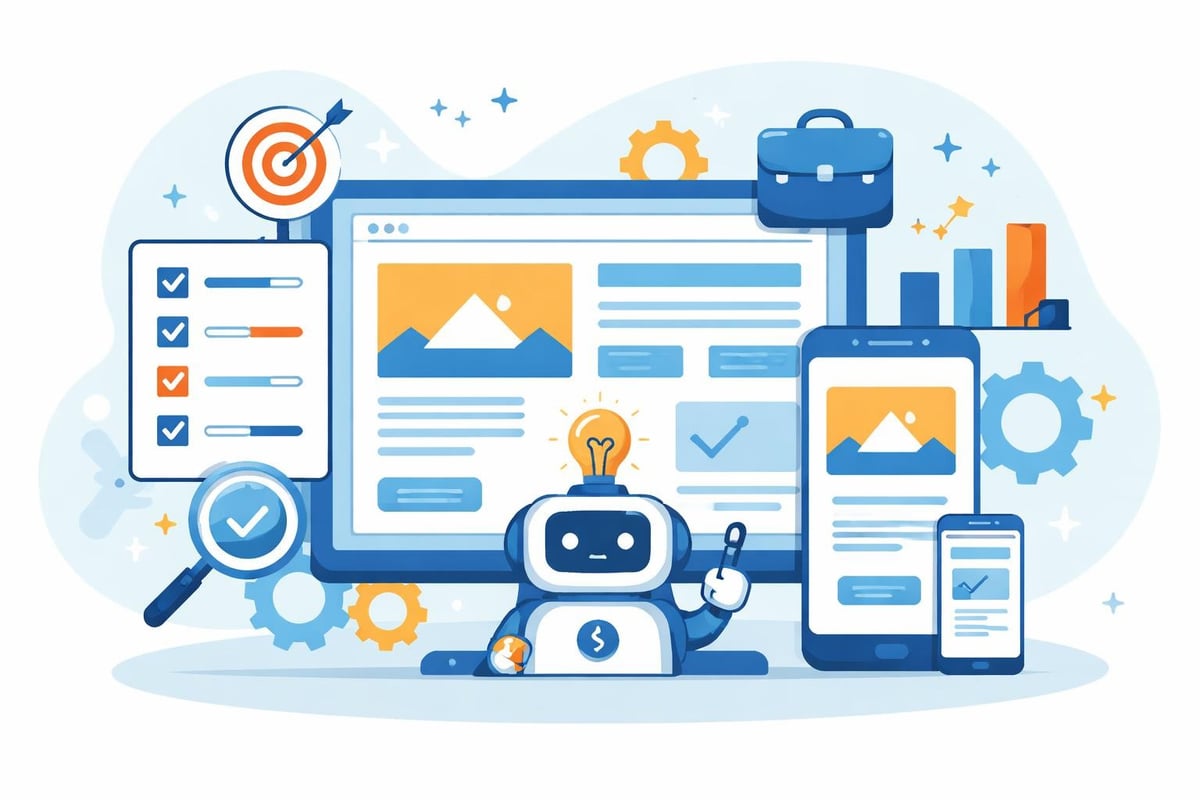
AI tools now generate complete page layouts based on content type and business objectives. Instead of starting with a blank canvas, designers work with AI-generated templates that already incorporate best practices for the specific use case.
- Content-aware structures that adapt to text length and media types
- Responsive breakpoints calculated automatically for optimal mobile experience
- Accessibility compliance built into every generated component
- Brand consistency maintained across all pages through learned style systems
The technology analyzes your content and automatically suggests grid systems, spacing, and hierarchies that guide user attention to conversion points. This doesn't eliminate human creativity but rather accelerates the technical implementation phase.
| Traditional Design Process | Website Design By AI | Time Savings |
|---|---|---|
| Initial wireframes (1-2 weeks) | AI layout generation (hours) | 90-95% |
| Design revisions (2-3 weeks) | Instant variations (minutes) | 95-98% |
| Responsive coding (2-4 weeks) | Automated responsive output (hours) | 90-95% |
| Browser testing (1 week) | Pre-tested components (hours) | 85-90% |
Code Generation and Optimization
Perhaps the most transformative aspect of website design by AI is its ability to write production-quality code. Modern platforms generate clean, semantic HTML, efficient CSS, and optimized JavaScript that often outperforms hand-coded alternatives.
These systems understand modern web standards, performance optimization techniques, and security best practices. They automatically implement lazy loading for images, code splitting for faster initial page loads, and proper caching strategies. The web design process becomes fundamentally more efficient when AI handles the technical infrastructure while humans focus on strategy and brand differentiation.
Essential AI Design Tools For Business Websites
The market has matured significantly, and several platforms now offer enterprise-grade capabilities for website design by AI. Understanding which tools serve which purposes helps businesses make informed technology decisions.
Comprehensive Website Builders
AI-powered website builders represent the most accessible entry point for businesses. These platforms combine design intelligence with hosting, security, and maintenance in single packages.
- Wix ADI analyzes your industry and content to generate complete websites
- Framer AI converts natural language descriptions into interactive prototypes
- 10Web rebuilds existing websites with AI optimization in minutes
- Durable creates entire business websites from simple prompts
- Hostinger AI Builder generates custom designs with brand-specific styling
These tools excel at standard business websites but may lack flexibility for complex custom requirements. They work best for companies prioritizing speed to market over unique functionality.
Specialized Design Components
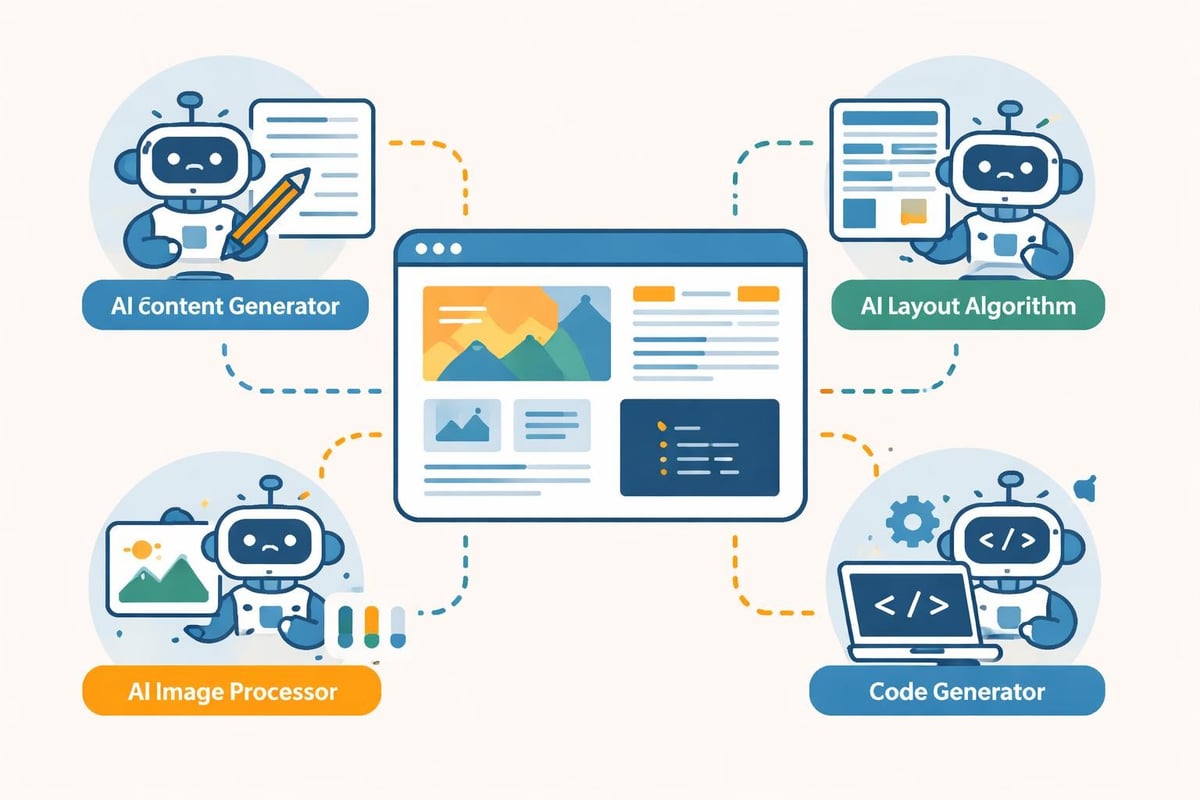
More advanced implementations use AI for specific design challenges rather than complete automation. Component-level AI assists with particular elements while designers maintain overall creative control.
- Copy.ai and Jasper generate website content that matches brand voice
- Khroma creates custom color palettes based on preferences
- Fontjoy pairs typography using deep learning algorithms
- Remove.bg handles image background removal at scale
- Let's Enhance upscales images without quality loss
This hybrid approach combines human strategic thinking with AI execution speed. Designers leverage AI design tools for tedious tasks while focusing creative energy on differentiation and user experience innovation.
Performance Advantages Of AI-Generated Websites
Speed and efficiency represent obvious benefits, but website design by AI delivers performance improvements that directly impact business outcomes. These technical advantages translate into better search rankings, higher conversion rates, and reduced operational costs.
Automated Technical SEO
AI platforms build technical SEO best practices into every generated page. They understand search engine requirements and implement them automatically, eliminating common mistakes that plague manually coded sites.
Core Web Vitals optimization happens by default. AI systems generate lightweight code, properly sized images, and efficient loading sequences that score well on Google's performance metrics. These technical foundations matter increasingly as search algorithms prioritize user experience signals.
The connection between technical implementation and search visibility grows stronger each year. Websites built with proper structure from the foundation avoid costly reconstruction projects later. This architectural advantage compounds over time as SEO strategies build on solid technical groundwork.
Continuous Optimization Capabilities
Traditional websites remain static between redesign cycles, but website design by AI enables continuous improvement. Machine learning algorithms monitor user behavior and automatically adjust elements to improve performance.
| Optimization Area | AI Capability | Business Impact |
|---|---|---|
| Conversion rate | A/B tests layouts automatically | 15-40% increase in conversions |
| Page speed | Optimizes resource loading | 25-50% faster load times |
| Mobile experience | Adapts to device patterns | 20-35% lower bounce rates |
| Accessibility | Ensures WCAG compliance | Broader audience reach |
These systems identify which headlines generate clicks, which calls-to-action drive conversions, and which layouts keep visitors engaged. They make incremental improvements constantly rather than waiting for major redesign initiatives.
Strategic Implementation For Business Success
Adopting website design by AI requires more than selecting tools. Successful implementation demands strategic thinking about how artificial intelligence fits within broader business objectives and brand positioning.
Defining Clear Objectives First
The most common mistake businesses make is jumping directly into AI tools without articulating what success looks like. Clear goals guide AI implementation toward meaningful outcomes rather than impressive but unfocused capabilities.
Start by identifying specific business problems the website must solve. Are you generating leads? Selling products? Building authority? Providing customer support? Each objective requires different design approaches, and AI systems perform best when given precise targets.
Document your target audience with specificity. AI performs better when it understands who will use the site, what devices they prefer, and what tasks they need to accomplish. This context enables more relevant design recommendations and smarter optimization decisions.
Balancing Automation With Brand Identity
Website design by AI excels at technical implementation and pattern recognition, but authentic brand expression still requires human judgment and creativity. The most successful websites combine AI efficiency with human strategic direction.
Develop comprehensive brand guidelines before engaging AI tools. Define your visual identity, voice, messaging hierarchy, and differentiation strategy. Feed these parameters into AI systems as constraints and guardrails that keep generated designs on brand.
Think of AI as amplifying human creativity rather than replacing it. Designers focus on strategic decisions about positioning, messaging, and experience architecture while AI handles technical execution. This division of labor produces better results than either approach alone.
Integration With Existing Systems
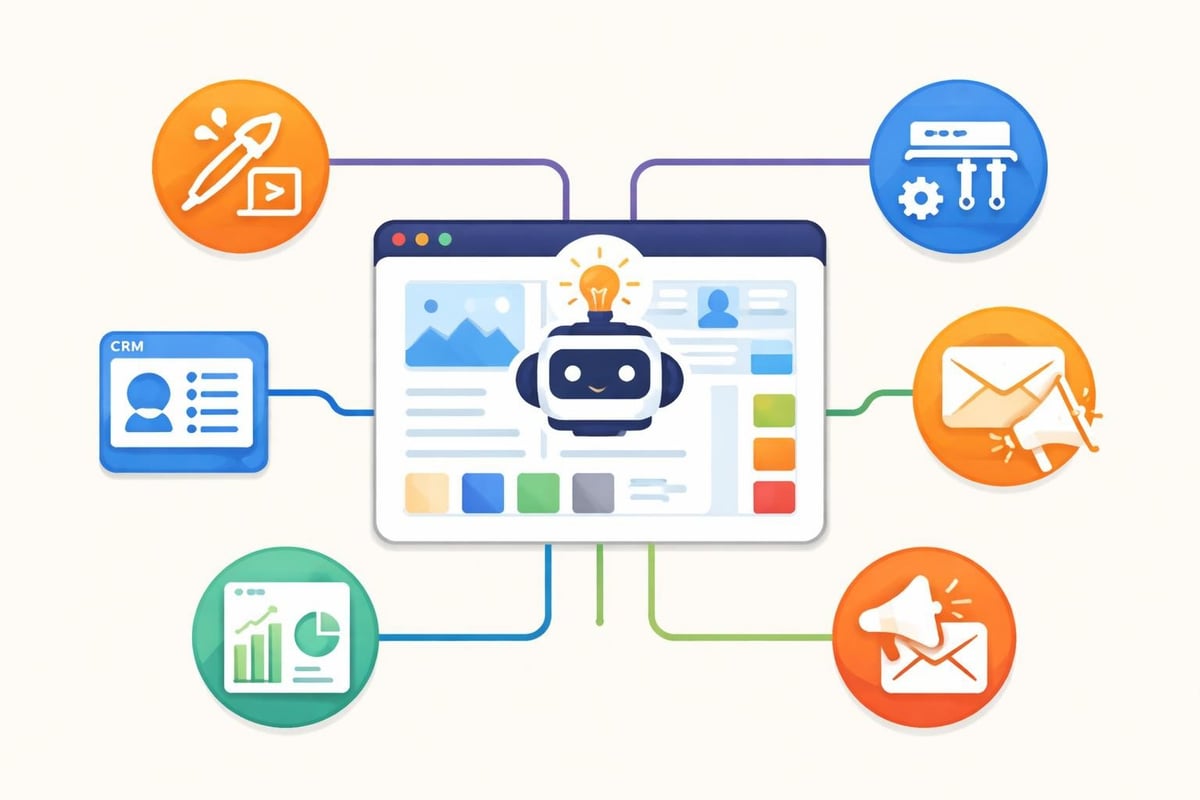
Most businesses operate complex technology ecosystems with CRM platforms, marketing automation, analytics tools, and content management systems. Website design by AI must integrate seamlessly with these existing investments.
API connectivity represents a critical evaluation criterion. Ensure AI platforms can exchange data with your marketing stack, sync customer information, and trigger automated workflows based on website interactions. Isolated systems create inefficiencies that negate time savings from faster design processes.
Consider how content flows through your organization. Can marketing teams update AI-generated pages without developer involvement? Do approval workflows accommodate AI's rapid iteration cycles? Operational compatibility matters as much as technical capability.
Future Developments Shaping AI Web Design
The technology continues evolving rapidly, and understanding emerging capabilities helps businesses prepare for next-generation opportunities. Website design by AI in 2026 looks dramatically different from even two years ago, and the pace of innovation accelerates.
Personalization At Scale
Next-generation AI platforms generate unique website experiences for each visitor based on behavioral patterns, demographics, and contextual signals. Hyper-personalized interfaces adapt layouts, messaging, and functionality to individual user needs in real-time.
These systems analyze thousands of data points to predict what each visitor wants to accomplish and restructure the site accordingly. A returning customer sees different navigation than a first-time visitor. Someone researching solutions gets educational content while someone ready to buy sees product comparisons.
This capability transforms static websites into dynamic platforms that optimize themselves continuously for each user segment. The business maintains one codebase while AI generates thousands of customized experiences.
Voice and Natural Language Interfaces
As conversational AI matures, website design by AI increasingly incorporates voice interaction and natural language navigation. Users describe what they're looking for instead of clicking through menus.
Multimodal interfaces combine traditional visual design with conversational elements. AI understands user intent from text or voice input and guides them directly to relevant content or functionality. This reduces friction in the customer journey and improves task completion rates.
The shift requires rethinking information architecture around question-answer patterns rather than hierarchical menus. AI helps map user questions to content and generate navigation systems that support both traditional and conversational access methods.
Predictive Design Generation
Current AI platforms generate designs based on explicit inputs and requirements. Emerging systems predict what businesses need before they articulate requirements by analyzing industry trends, competitor strategies, and market dynamics.
These predictive capabilities recommend design directions based on where industries are heading rather than where they currently stand. AI identifies emerging user behavior patterns and suggests interface innovations that anticipate future needs.
For businesses, this means staying ahead of design trends rather than following them. Websites remain modern longer and require less frequent overhauls because AI builds in forward-looking capabilities from inception.
Measuring ROI From AI Website Design
Investment in website design by AI requires justification through measurable business outcomes. Understanding which metrics matter and how to attribute results helps secure ongoing investment and refine implementation strategies.
Time-to-Market Metrics
The most immediate benefit appears in accelerated launch timelines. Track calendar days from project initiation to live deployment and compare against historical benchmarks for traditional development.
- Initial design concepts: hours instead of weeks
- Functional prototypes: days instead of months
- Production deployment: weeks instead of quarters
- Post-launch iterations: hours instead of days
Faster launches mean capturing market opportunities sooner and testing business hypotheses with real customers rather than internal stakeholders. This velocity advantage compounds across multiple projects and updates.
Cost Efficiency Analysis
Website design by AI typically reduces total development costs by 40-70% compared to traditional agency engagements or in-house teams. Calculate fully loaded costs including:
| Cost Category | Traditional Approach | AI-Assisted Approach | Savings |
|---|---|---|---|
| Design labor | $15,000-30,000 | $3,000-8,000 | 60-80% |
| Development labor | $25,000-50,000 | $5,000-15,000 | 65-80% |
| Revisions | $5,000-15,000 | $500-2,000 | 85-95% |
| Ongoing maintenance | $2,000-5,000/month | $500-1,500/month | 60-75% |
These savings enable businesses to invest more in marketing, content creation, and customer acquisition while maintaining modern digital presence. The website design approach you choose directly impacts budget allocation across the entire marketing function.
Business Performance Indicators
Ultimately, website design by AI must drive revenue, leads, or other core business metrics. Establish clear attribution models that connect design improvements to outcomes.
Monitor conversion rate changes after implementing AI-generated designs. Track lead quality and volume. Measure customer acquisition costs and lifetime value for visitors from organic search. Performance data validates the investment and guides future optimization priorities.
Compare engagement metrics like time on site, pages per session, and bounce rates against previous benchmarks. AI-optimized designs should show measurable improvements in these indicators as layouts better match user intent and expectations.
Common Challenges And Practical Solutions
Despite significant advantages, website design by AI introduces unique challenges that businesses must address proactively. Understanding these obstacles and planning mitigation strategies improves implementation success rates.
Managing Generic Design Outputs
AI platforms train on massive datasets of existing websites, which can lead to designs that feel generic or derivative. Differentiation requires intentional effort when working with AI-generated foundations.
Combat this by developing strong brand guidelines before engaging AI tools. Provide extensive examples of approved visual directions, competitive differentiation strategies, and unique value propositions. The more context AI receives, the more customized outputs become.
Layer human creative direction on top of AI-generated structures. Use AI for technical scaffolding and responsive frameworks while designers inject brand personality through custom illustrations, photography, typography treatments, and interaction details.
Ensuring Accessibility Compliance
While many AI platforms claim accessibility features, WCAG compliance requires verification and often manual refinement. Automated tools catch obvious issues but miss nuanced problems affecting disabled users.
Implement human accessibility audits on AI-generated designs before launch. Test with actual assistive technologies and real users with disabilities. Many AI platforms generate technically compliant code that still creates poor experiences for screen reader users or keyboard-only navigation.
Establish accessibility requirements as non-negotiable constraints in AI design briefs. Specify color contrast ratios, text sizing, semantic HTML structure, and ARIA labeling standards upfront rather than attempting fixes after generation.
Maintaining Design Consistency Across Updates
Website design by AI enables rapid updates and continuous optimization, but consistency challenges emerge when different team members generate new pages or sections independently.
Create comprehensive design systems that constrain AI outputs to approved patterns. Document component libraries, spacing systems, typography scales, and interaction patterns that all generated designs must follow. This ensures visual coherence even as content and layouts evolve.
Implement review workflows that validate new AI-generated sections against established patterns before deployment. Designate brand guardians who verify consistency and approve variations that extend the system appropriately.
Website design by AI represents a fundamental shift in how businesses approach digital presence, delivering unprecedented speed, efficiency, and performance optimization. The technology has matured to the point where AI-assisted design produces better business outcomes than traditional methods for most use cases. Strategic implementation combines AI's technical capabilities with human creativity and brand expertise to create websites that both perform exceptionally and express authentic brand identity. Creotivity specializes in leveraging AI to build high-performing websites that rank on Google and AI search engines while maintaining the unique brand positioning that sets your business apart. Ready to transform your digital presence with intelligent design?