
AI Website Building: The Future of Web Design in 2026
The landscape of web development has transformed dramatically over the past few years, with artificial intelligence reshaping how businesses and individuals create their online presence. AI website building has emerged as a revolutionary approach that democratizes web design, making professional-quality websites accessible to anyone regardless of technical expertise. This technology combines machine learning algorithms, natural language processing, and design automation to generate fully functional websites in minutes rather than weeks. As we navigate through 2026, understanding the capabilities, limitations, and strategic applications of AI website building has become essential for businesses looking to establish or enhance their digital footprint.
Understanding the Core Technology Behind AI Website Building
Modern AI website building platforms leverage sophisticated neural networks trained on millions of existing websites to understand design principles, user experience patterns, and content structure. These systems analyze user inputs, brand information, and industry-specific requirements to generate customized websites that align with professional standards.
The technology operates through several integrated components. Natural language processing interprets conversational instructions from users, translating simple descriptions into design specifications. Computer vision algorithms analyze uploaded images and logos to extract color palettes and brand elements. Generative AI models create original copy, suggest layouts, and even produce visual assets tailored to specific industries.
How AI Interprets Design Intent
When users interact with AI website builders, they typically provide information about their business, target audience, and aesthetic preferences. The AI processes this information through decision trees that map business types to proven design patterns. For instance, an e-commerce site receives different structural recommendations than a portfolio site for creative professionals.
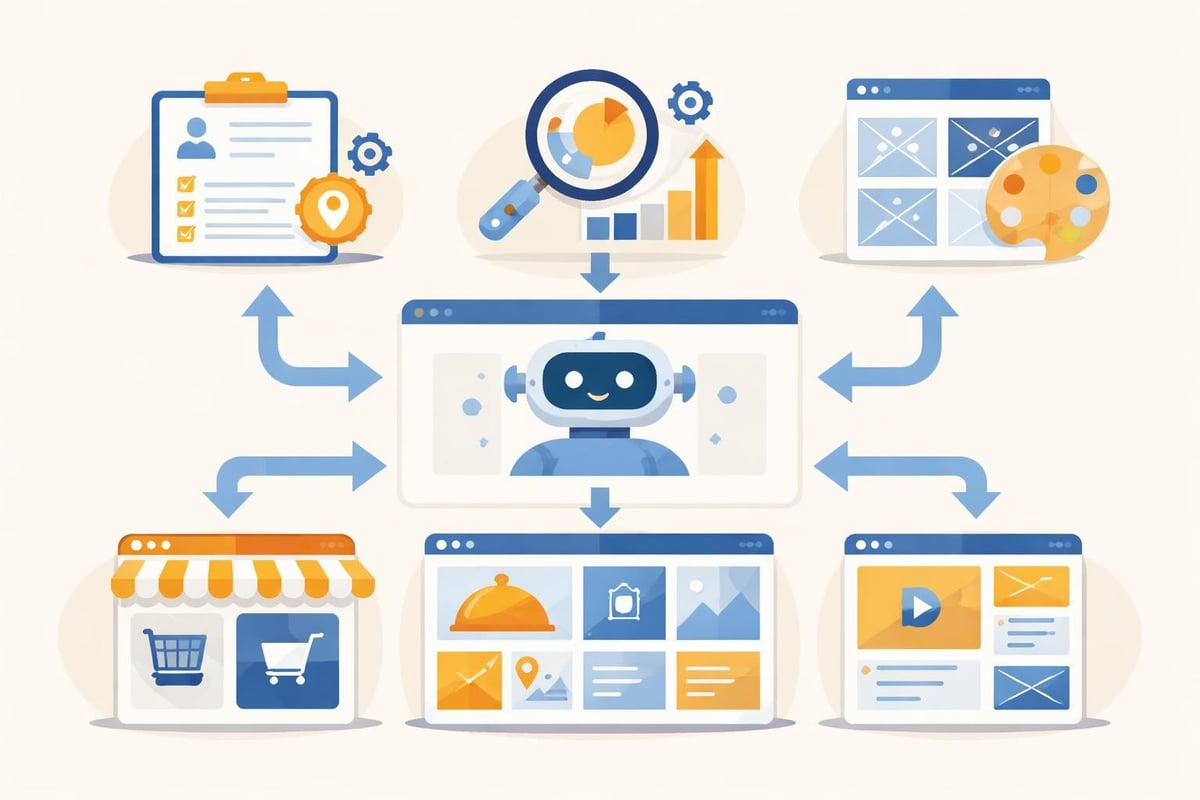
The sophistication of these platforms has reached a point where platforms like Wix's Harmony AI can generate entire websites from conversational prompts, blending automation with creative flexibility.
Key Features Transforming the Website Building Process
AI website building platforms in 2026 offer capabilities that extend far beyond basic template customization. These features represent fundamental shifts in how websites are conceived, designed, and deployed.
Intelligent Content Generation produces industry-specific copy that matches brand voice and SEO requirements. The AI analyzes competitor websites, industry terminology, and search intent to create relevant, engaging content that resonates with target audiences.
Automated Design Systems select color schemes, typography, and layout structures based on psychological principles and conversion optimization data. These systems continuously learn from A/B testing results across millions of websites to recommend design choices with proven performance metrics.
Responsive Optimization ensures websites function flawlessly across all devices without manual adjustments. AI automatically restructures layouts, resizes images, and reorganizes navigation elements for optimal mobile and tablet experiences.
| Feature | Traditional Building | AI Website Building |
|---|---|---|
| Design Time | 2-8 weeks | Minutes to hours |
| Technical Skills Required | High | Minimal |
| Customization Depth | Unlimited | Extensive but bounded |
| Content Creation | Manual | AI-assisted or automated |
| Cost | $3,000-$50,000+ | $0-$500/year |
| Maintenance | Ongoing developer costs | Automated updates |
Advanced Personalization Capabilities
Modern AI website building tools incorporate adaptive personalization that adjusts content and layout based on visitor behavior. These systems track engagement patterns and automatically optimize elements to improve conversion rates. The technology can create dynamic experiences where returning visitors see different content arrangements optimized for their previous interactions.
Strategic Advantages for Businesses
Organizations adopting AI website building solutions gain competitive advantages that extend beyond cost savings. The speed-to-market advantage allows businesses to launch campaigns, test product offerings, and respond to market opportunities with unprecedented agility.
Reduced Technical Barriers enable marketing teams to create and modify web properties without depending on development resources. This autonomy accelerates iteration cycles and empowers teams to experiment with messaging and positioning.
Consistency at Scale becomes achievable when AI maintains brand standards across multiple pages or even multiple websites. The technology enforces design guidelines, color usage, and typographic hierarchy automatically, ensuring professional coherence that manual processes often struggle to maintain.
For agencies focused on website design and SEO, AI website building tools have become essential components of efficient service delivery, allowing professionals to focus on strategic planning rather than repetitive implementation tasks.
- Cost efficiency: Reduces development expenses by 60-80% compared to traditional custom builds
- Rapid prototyping: Creates functional mockups in hours for client review and stakeholder feedback
- Accessibility: Opens web design to non-technical business owners and entrepreneurs
- Continuous improvement: Implements updates and security patches automatically without manual intervention
- Data-driven design: Leverages performance analytics from millions of websites to inform design decisions
Navigating the Limitations and Challenges
Despite remarkable advances, AI website building technology faces constraints that businesses must understand to make informed decisions. The balance between automation and customization remains a fundamental challenge that affects project suitability.
Technical and Creative Boundaries
Complex functionality requirements often exceed AI builder capabilities. E-commerce platforms with extensive product catalogs, custom checkout flows, or integration with legacy systems may require traditional development approaches. Similarly, brands with highly specific visual identities may find AI-generated designs too constrained by template boundaries.
The proliferation of AI-generated content has raised concerns about website authenticity and quality. While AI excels at producing functional websites quickly, the output sometimes lacks the nuanced creativity and strategic thinking that experienced designers bring to complex projects.
Performance optimization represents another area where AI website building platforms sometimes fall short. Automated systems may generate code that prioritizes speed of creation over execution efficiency, potentially impacting page load times and user experience. Businesses focused on fast websites need to carefully evaluate the technical performance of AI-generated solutions.
- Evaluate project complexity before selecting AI website building as the primary approach
- Review generated code quality to ensure performance standards are met
- Test across multiple devices since AI-generated responsive design may have edge cases
- Verify SEO implementation as automated systems sometimes miss technical optimization opportunities
- Plan for scalability by understanding how the platform handles growth and feature additions
Integration with Modern Web Ecosystems
AI website building platforms in 2026 function as components within larger digital ecosystems rather than isolated solutions. The ability to connect with marketing automation, customer relationship management, and analytics platforms determines practical utility for growing businesses.
API Connections and Third-Party Tools
Leading AI website builders offer extensive integration libraries that connect with popular business tools. These connections enable data flow between websites and operational systems, creating unified customer experiences. For example, form submissions can automatically populate CRM records, while inventory systems update product availability in real-time.
The integration capabilities extend to AI search engines and emerging generative platforms. Forward-thinking businesses ensure their AI-built websites include structured data markup and machine-readable content that performs well in both traditional search results and AI-generated responses.
| Integration Type | Business Value | Complexity Level |
|---|---|---|
| Email Marketing | Automated lead nurturing | Low |
| CRM Systems | Unified customer data | Medium |
| Analytics Platforms | Behavior tracking and insights | Low |
| E-commerce Gateways | Transaction processing | Medium |
| Social Media Feeds | Dynamic content updates | Low |
| Booking Systems | Appointment management | Medium |
Contemporary AI website building platforms recognize that websites no longer exist in isolation. They must serve as nodes in interconnected digital presences that span social media, search engines, and increasingly, AI-powered discovery tools.
Optimizing AI-Built Websites for Search Visibility
While AI website building platforms automate many technical aspects of web design, achieving strong search engine rankings requires strategic input that goes beyond automated defaults. The relationship between AI-generated websites and search performance depends heavily on how businesses guide and refine the output.
Content depth and quality remain critical factors that AI alone cannot fully address. Search engines in 2026 prioritize comprehensive, authoritative content that demonstrates genuine expertise. Businesses must supplement AI-generated copy with industry-specific insights, original research, and unique value propositions that differentiate their offerings.
Technical SEO foundations need verification even when using AI website building tools. While these platforms typically implement basic optimization like meta tags and mobile responsiveness, advanced elements such as schema markup, page speed optimization, and crawl efficiency may require manual attention. The reality is that AI has exposed weak content foundations across many websites, making quality implementation more important than ever.
Structured Data and AI Discoverability
Websites built for 2026 must consider visibility across both traditional search engines and AI-powered answer engines. This dual optimization requires implementing rich structured data that helps algorithms understand content context and relationships. AI website builders with robust schema implementation provide advantages in this evolving landscape.
Agencies like Creotivity use AI to drastically accelerate the coding and structural setup of client sites while ensuring that SEO fundamentals remain strong, demonstrating how professional expertise enhances AI website building capabilities.
- Verify that AI-generated meta descriptions accurately represent page content and include target keywords
- Review heading hierarchy to ensure logical structure for both users and search crawlers
- Add original, expert-level content to pages that AI populated with generic copy
- Implement comprehensive internal linking strategies that AI builders may overlook
- Test mobile usability beyond basic responsiveness to ensure excellent user experience
- Monitor Core Web Vitals and page speed metrics, optimizing where AI defaults underperform
Selecting the Right AI Website Building Platform
The market for AI website building solutions has expanded significantly, with platforms offering varying capabilities, pricing models, and target audiences. Choosing the appropriate tool requires matching business requirements with platform strengths.
Platform Categories and Use Cases
All-in-one website builders like Wix's AI Website Builder combine hosting, design, and AI automation in single packages suited for small businesses and entrepreneurs. These platforms prioritize ease of use and quick deployment over granular customization.
AI design assistants work alongside traditional website builders, offering intelligent suggestions while preserving human control. Squarespace's Blueprint AI exemplifies this approach, generating starting points that designers refine according to specific requirements.
Specialized AI tools focus on particular aspects of website creation, such as transforming existing sites into editable templates. MagicPath's "Web to Design" feature demonstrates how AI can analyze and recreate website designs, useful for redesign projects or competitive analysis.
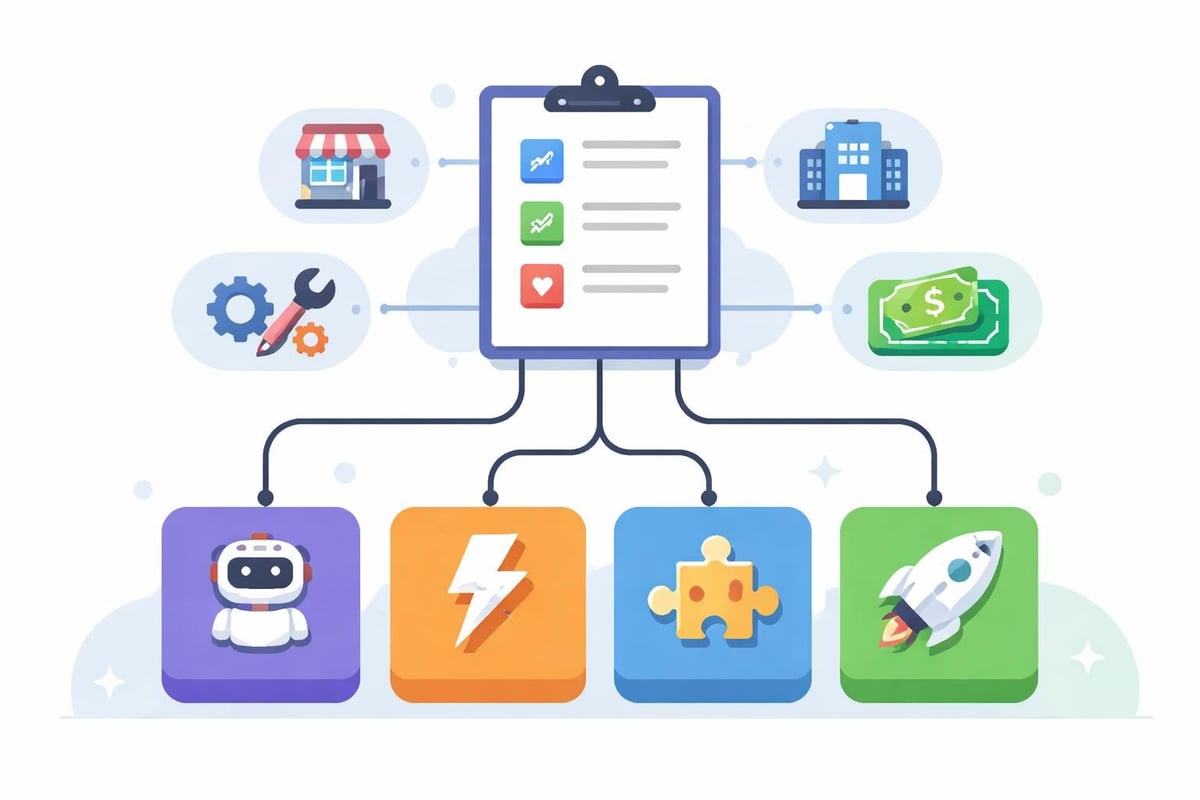
When evaluating platforms, businesses should consider the following decision matrix:
| Consideration | Questions to Ask | Weight |
|---|---|---|
| Industry Fit | Does the platform excel with my business type? | High |
| Customization Needs | Can I modify AI outputs to match brand standards? | High |
| Growth Trajectory | Will the platform scale with business expansion? | Medium |
| Integration Requirements | Does it connect with existing business systems? | High |
| Budget Constraints | What are total costs including add-ons and fees? | Medium |
| Support Quality | Is expert help available when needed? | Medium |
Future Trajectories in AI Website Building
The evolution of AI website building technology shows no signs of slowing as we progress through 2026 and beyond. Several emerging trends indicate where the industry is heading and what capabilities businesses can anticipate.
Multimodal AI interfaces will enable website creation through voice commands, sketch inputs, and even mood boards. Users will communicate design intent through whatever medium feels most natural, with AI translating these diverse inputs into coherent website structures.
Predictive design optimization will leverage historical performance data to automatically adjust websites based on industry trends, seasonal patterns, and competitor movements. These systems will proactively suggest changes before performance metrics decline.
Hyper-personalization engines will create unique website experiences for individual visitors based on comprehensive behavioral data, location information, and predictive analytics about user intent and preferences.
The convergence of AI website building with broader digital marketing automation will create self-optimizing web presences that continuously adapt to maximize business objectives. Websites will evolve from static artifacts into dynamic, intelligent platforms that actively participate in customer acquisition and retention strategies.
Ethical Considerations and Authenticity
As AI website building becomes more sophisticated, questions about authenticity, originality, and digital identity gain prominence. Businesses must balance the efficiency of AI-generated design with the need for distinctive brand expression that sets them apart in crowded markets.
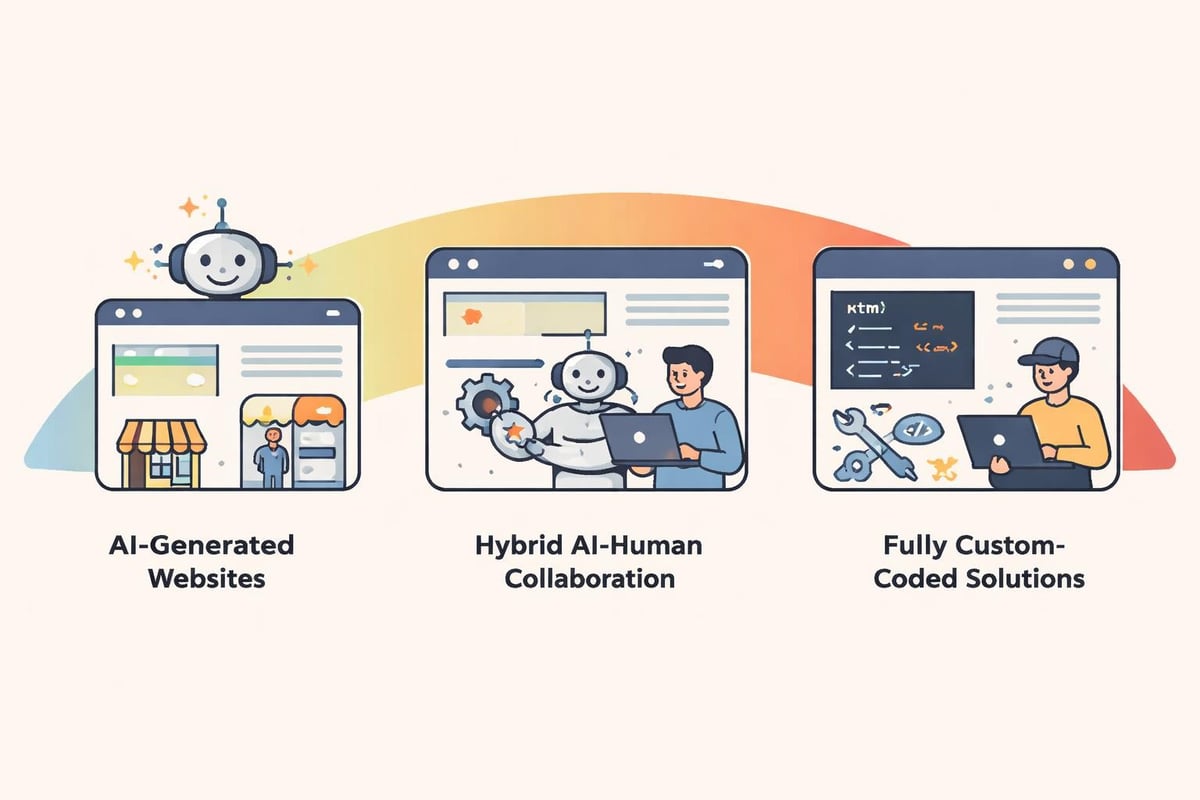
The most successful approaches to web design strategy in 2026 combine AI efficiency with human creativity, using automation to handle repetitive tasks while reserving strategic decisions for experienced professionals who understand business context and competitive positioning.
Implementing AI Website Building Successfully
Successful deployment of AI website building technology requires more than selecting a platform and generating a site. Strategic implementation involves preparation, refinement, and ongoing optimization that maximizes the technology's potential while mitigating its limitations.
Pre-build preparation significantly impacts output quality. Gathering brand assets, defining target audiences, clarifying value propositions, and documenting functional requirements before engaging AI tools produces better results than starting with vague concepts.
- Compile comprehensive brand guidelines including logos, color codes, typography preferences, and voice/tone documentation
- Map website structure by outlining primary pages, content hierarchy, and user journey flows
- Research competitor websites to identify design patterns and features relevant to your industry
- Define success metrics that will guide post-launch optimization and measure effectiveness
- Prepare content elements such as product descriptions, service explanations, and company information
- Identify required integrations with existing business systems and third-party tools
Post-Generation Refinement Process
AI-generated websites benefit enormously from human review and enhancement. The most effective workflow treats AI output as a sophisticated first draft that professionals refine into polished final products. This approach combines speed advantages with quality assurance.
Professional agencies understand that AI website building accelerates the foundation while strategic expertise ensures the final product achieves business objectives and maintains competitive advantages in search rankings and user engagement.
Businesses seeking to rank highly on both traditional search engines and emerging AI platforms must ensure their websites include authoritative content, clear structural signals, and technical excellence that automated systems alone may not fully achieve.
Measuring Success and ROI
Quantifying the value of AI website building investments requires tracking metrics that reflect both cost savings and business outcomes. The financial benefits extend beyond obvious development cost reductions to include opportunity costs, time-to-market advantages, and operational efficiencies.
Direct cost comparisons between traditional development and AI website building typically show 60-80% reductions in initial build expenses. However, total cost of ownership must account for ongoing maintenance, updates, platform fees, and potential migration costs if business needs outgrow the platform.
Time savings translate to competitive advantages when businesses can launch campaigns, respond to market opportunities, or test new offerings weeks or months faster than competitors relying on traditional development cycles.
Performance metrics should encompass both technical and business dimensions:
- Page load speeds and Core Web Vitals scores
- Search engine rankings for target keywords
- Organic traffic volume and growth trajectory
- Conversion rates across key user actions
- Bounce rates and engagement metrics
- Mobile usability scores and device-specific performance
- Accessibility compliance levels
- Integration reliability and data synchronization accuracy
For businesses focused on sustainable growth, the question extends beyond whether AI website building produces functional websites to whether those websites drive measurable business results that justify the approach versus alternatives.
AI website building has matured into a powerful option for businesses seeking efficient, professional web presences without the complexity and cost of traditional development. The technology excels at democratizing web design while maintaining professional standards, though strategic expertise remains essential for competitive differentiation and optimal performance. Creotivity combines AI efficiency with professional design and SEO expertise to build modern websites that rank highly on both traditional search engines and emerging AI platforms, helping businesses establish commanding online presences that attract and convert customers.