
Web Design Strategy: Build Sites That Convert in 2026
A successful website doesn't happen by accident. It emerges from a carefully crafted web design strategy that aligns business objectives with user needs while accounting for emerging technologies like AI search engines. In 2026, businesses face an increasingly complex digital landscape where traditional design approaches no longer suffice. Your website must simultaneously satisfy human visitors, traditional search algorithms, and AI-powered search platforms while delivering measurable business results. This comprehensive approach requires strategic thinking from the initial concept through launch and beyond.
Understanding Web Design Strategy Fundamentals
Web design strategy encompasses far more than choosing colors and layouts. It's a systematic approach to creating digital experiences that serve specific business purposes while meeting user expectations.
A robust web design strategy begins with clearly defined objectives. Are you generating leads, selling products, building brand awareness, or educating your audience? Each goal demands different design decisions, content structures, and conversion pathways. Your strategy must translate business requirements into actionable design principles that guide every decision throughout the project.
Strategic Planning Components
The foundation of effective web design strategy includes several interconnected elements:
- Business goal alignment ensures every design choice supports measurable objectives
- Target audience research reveals the preferences, behaviors, and pain points of your ideal visitors
- Competitive analysis identifies opportunities to differentiate your brand
- Technical requirements define the platforms, integrations, and performance standards needed
- Content strategy maps the information architecture and messaging framework
- Success metrics establish clear benchmarks for measuring performance
Understanding user-centered design principles helps ensure your strategy prioritizes actual user needs rather than assumptions. This approach reduces costly revisions and creates websites that genuinely resonate with your target audience.

Aligning Design Decisions With Business Objectives
Every visual element, interaction pattern, and content block should advance your core business goals. This alignment transforms your website from a digital brochure into a strategic business asset.
Translating Goals Into Design Requirements
When your objective is lead generation, your web design strategy emphasizes clear value propositions, prominent contact forms, and trust signals like testimonials and certifications. The visual hierarchy guides visitors toward conversion points while maintaining a professional aesthetic that builds credibility.
E-commerce objectives require different strategic choices. Product photography quality, filtering capabilities, checkout flow optimization, and mobile shopping experiences become critical success factors. Your strategy must account for the entire customer journey from discovery through purchase and beyond.
Brand awareness campaigns demand strategies focused on storytelling, emotional engagement, and shareability. These sites often prioritize visual impact, multimedia content, and social integration over immediate conversions.
| Business Objective | Strategic Design Priorities | Key Success Metrics |
|---|---|---|
| Lead Generation | Clear CTAs, trust signals, form optimization | Conversion rate, lead quality, cost per lead |
| E-commerce Sales | Product presentation, checkout simplicity, mobile experience | Revenue, cart abandonment, average order value |
| Brand Awareness | Visual storytelling, emotional design, social sharing | Engagement time, social shares, brand recall |
| Customer Education | Content organization, search functionality, resource accessibility | Time on page, resource downloads, return visits |
Modern web design strategy must also account for how AI search engines surface and present your content, ensuring your site remains discoverable as search behavior evolves.
User Research and Audience Analysis
Strategic design decisions require deep understanding of who will use your website and what they're trying to accomplish. User research transforms guesses into insights.
Effective audience analysis combines quantitative data with qualitative insights. Analytics reveal what visitors do, showing which pages they visit, where they abandon the journey, and which devices they use. User interviews and surveys explain why they behave that way, uncovering motivations, frustrations, and unmet needs.
Research Methods That Inform Strategy
- User persona development creates detailed profiles of your ideal visitors, including demographics, goals, challenges, and decision-making criteria
- Customer journey mapping identifies every touchpoint from awareness through conversion and retention
- Usability testing reveals friction points in existing designs or prototypes before launch
- Heatmap analysis shows where users focus attention and how they navigate pages
- Competitive user experience audits benchmark your experience against industry standards
This research directly informs your web design strategy by revealing which features matter most, what content users seek, and how they prefer to interact with websites in your industry. The investment in research prevents expensive redesigns and creates experiences that genuinely serve user needs.
Information Architecture and Content Strategy
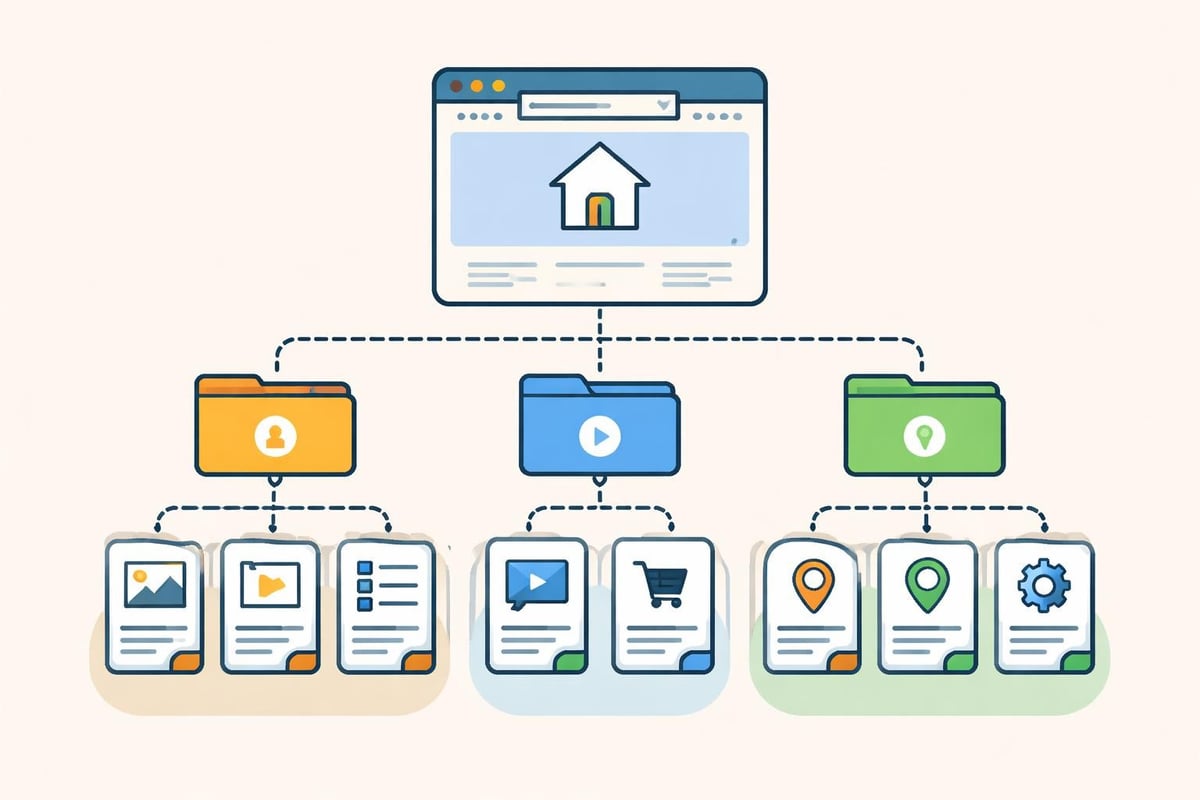
How you organize and present information fundamentally shapes user experience and conversion potential. Strategic information architecture creates intuitive pathways to key content.
Your web design strategy must account for both human navigation patterns and how search engines (traditional and AI-powered) understand site structure. A well-planned information architecture serves both audiences simultaneously.
Building Logical Site Structures
Navigation should reflect how users think about your products or services, not your internal organizational chart. Start with card sorting exercises where representative users group and label your content categories based on their mental models.
Primary navigation typically handles 5-7 main sections maximum. Beyond that, users experience decision paralysis. Secondary and tertiary content lives in well-organized submenus or can be reached through contextual links and internal search.
- Flat hierarchies keep important pages within 2-3 clicks of the homepage
- Consistent navigation patterns reduce cognitive load across the site
- Clear labeling conventions use language your audience understands, not industry jargon
- Strategic internal linking creates topical clusters that reinforce subject authority
Content strategy determines what information appears on each page, in what order, and with what emphasis. This strategic layer ensures your messaging supports business goals while addressing user questions at each stage of their journey. Understanding how websites perform in modern search environments helps inform content decisions that maximize discoverability.
Responsive Design and Multi-Device Considerations
With over 60% of web traffic originating from mobile devices in 2026, your web design strategy must prioritize responsive experiences across all screen sizes and contexts.
Responsive web design isn't merely about shrinking desktop layouts to fit smaller screens. It requires rethinking interface patterns, interaction methods, and content priorities for different contexts.
Mobile-First Strategic Approach
Starting with mobile constraints forces clarity. Limited screen real estate demands ruthless prioritization of content and features. This discipline often improves desktop experiences as well, eliminating unnecessary elements that dilute focus.
Touch targets must be sized appropriately (minimum 44x44 pixels) with adequate spacing to prevent accidental taps. Form fields should leverage mobile-specific input types that trigger appropriate keyboards. Images and videos require optimization strategies that balance quality with load times on cellular connections.
Your strategy should also account for different usage contexts. Mobile users often seek specific information quickly (hours, contact details, directions), while desktop users may engage in more extended research or complex tasks. Adaptive content strategies serve different needs based on device type without creating entirely separate experiences.
Visual Design Systems and Brand Consistency
Strategic visual design creates immediate recognition while guiding users toward desired actions. A cohesive design system ensures consistency across every touchpoint.
Modern web design strategy establishes design tokens that define colors, typography, spacing, and component behaviors. These reusable elements maintain brand consistency while enabling efficient design and development workflows.
Strategic Visual Hierarchy
Visual hierarchy directs attention to elements in order of importance. Your web design strategy uses size, color, contrast, and positioning to create clear focal points and guide users through content logically.
Typography choices communicate brand personality while ensuring readability across devices. Heading hierarchies establish clear content relationships. Body text must be legible at various sizes without requiring zoom. Interactive elements need sufficient visual weight to signal their clickability.
Color strategy extends beyond aesthetics. It creates visual rhythm, distinguishes content types, and drives conversion actions through strategic contrast. Accessibility considerations ensure color isn't the only way to convey important information, serving colorblind users and meeting WCAG standards.
| Design Element | Strategic Purpose | Implementation Guideline |
|---|---|---|
| Color Palette | Brand recognition, emotional response, conversion emphasis | 3-5 primary colors with established contrast ratios |
| Typography | Readability, brand personality, content hierarchy | 2-3 typeface families with clear size scale |
| Spacing System | Visual rhythm, content grouping, breathing room | Consistent scale (often based on 4px or 8px increments) |
| Component Library | Efficiency, consistency, maintainability | Reusable elements with documented usage patterns |
Agencies like Creotivity leverage AI to accelerate the structural setup and coding processes, allowing more time for strategic design decisions that truly differentiate brands.
Performance Optimization as Strategy
Site speed directly impacts user satisfaction, conversion rates, and search rankings. Your web design strategy must treat performance as a feature, not an afterthought.
In 2026, users expect pages to load in under two seconds. Every additional second increases bounce rates exponentially. Core Web Vitals remain critical ranking factors for traditional search engines while also influencing how AI search platforms evaluate and recommend sites.
Strategic Performance Decisions
Performance optimization begins at the strategy phase, not during development. Decisions about image formats, third-party integrations, animation complexity, and framework choices all carry performance implications.
- Image strategy balances visual quality with file size through next-gen formats and responsive sizing
- Font loading prevents layout shifts and text delays through strategic preloading
- JavaScript budgets limit framework bloat that slows initial page loads
- Caching strategies accelerate repeat visits and reduce server load
- CDN implementation serves assets from geographically optimal locations
Web design principles emphasizing simplicity and universality often result in faster, more accessible experiences. Strategic minimalism removes unnecessary elements that slow performance without reducing effectiveness.

SEO and AI Search Integration
Your web design strategy in 2026 must account for how both traditional search engines and AI-powered platforms discover, understand, and present your content.
Technical SEO considerations shape structural decisions. URL structures, heading hierarchies, schema markup, and internal linking patterns all influence search visibility. These elements must be planned strategically, not added as afterthoughts.
Designing for AI Discoverability
AI search engines like ChatGPT, Claude, and Perplexity evaluate content differently than traditional algorithms. They prioritize clear, authoritative information presented in contextually rich formats. Your web design strategy should structure content to answer specific questions while establishing topical authority.
Structured data implementation helps AI systems understand relationships between content elements. Clear information hierarchies enable accurate content extraction. Comprehensive coverage of topics signals expertise that AI platforms reward with citations and recommendations.
The emerging field of AI optimization requires design strategies that make content easily parseable by language models while remaining engaging for human readers.
Conversion Rate Optimization Strategy
Driving traffic means nothing without conversions. Strategic design optimizes every element of the conversion funnel.
Conversion rate optimization (CRO) integrates psychological principles with data-driven testing. Your web design strategy identifies conversion barriers and systematically removes them through iterative improvements.
Strategic Conversion Elements
- Value proposition clarity ensures visitors immediately understand what you offer and why it matters
- Trust signals including testimonials, certifications, and security badges reduce purchase anxiety
- Friction reduction streamlines forms, checkout processes, and contact methods
- Urgency and scarcity tactics motivate action without appearing manipulative
- Social proof demonstrates that others have benefited from your products or services
A/B testing validates strategic hypotheses. Rather than testing random variations, strategic testing focuses on elements most likely to impact conversions based on user research and behavioral psychology.
Accessibility as Strategic Advantage
Accessible design isn't just ethical-it's strategic. Approximately 16% of the global population experiences some form of disability. Excluding them means excluding potential customers.
Your web design strategy should incorporate accessibility from the beginning. WCAG 2.1 compliance ensures your site works with screen readers, keyboard navigation, and assistive technologies. These considerations often improve usability for all users, not just those with disabilities.
Strategic accessibility includes semantic HTML that conveys document structure, sufficient color contrast for readability, alternative text for images, and keyboard-accessible interactions. These elements benefit users with disabilities while also improving SEO and creating more robust code.
Analytics and Continuous Improvement
Web design strategy doesn't end at launch. Strategic websites evolve based on real user data and changing business needs.
Analytics implementation should be planned during the strategy phase. What metrics matter for your specific goals? How will you track user journeys? What conversion events need measurement? Answering these questions upfront ensures you collect meaningful data from day one.
Data-Driven Iteration
Regular analysis reveals opportunities for improvement:
- User flow analysis shows where visitors abandon the journey
- Conversion funnel tracking identifies specific obstacles preventing goal completion
- Page performance monitoring detects speed issues affecting user experience
- Heatmap studies reveal how users actually interact with pages versus intended behavior
- Search query analysis uncovers content gaps and misaligned expectations
Strategic refinement based on this data creates compounding improvements over time. Small optimizations accumulate into significant performance gains when approached systematically.
Technology Stack Selection
Your web design strategy must consider which platforms, frameworks, and tools best serve your objectives and constraints.
Content management systems vary widely in capabilities, complexity, and maintenance requirements. WordPress offers flexibility and extensive plugin ecosystems but requires careful security management. Headless CMS options provide superior performance and security but demand more technical expertise.
Selecting technologies strategically means evaluating total cost of ownership, scalability potential, security implications, and team capabilities. The "best" technology is whichever aligns with your specific strategic requirements, not whatever is currently trending.
| Technology Factor | Strategic Considerations | Decision Impact |
|---|---|---|
| CMS Platform | Content flexibility, editor experience, plugin ecosystem | Long-term maintenance costs, capability limitations |
| Hosting Infrastructure | Performance, scalability, security, support | Site speed, uptime, growth accommodation |
| Development Framework | Load times, developer availability, update frequency | Initial build cost, ongoing maintenance |
| Third-Party Integrations | Data flow, reliability, vendor lock-in | Functionality expansion, dependency risks |
Looking ahead, understanding how AI is transforming web design helps inform technology choices that position your site for future evolution rather than immediate obsolescence.
Budget Allocation and ROI Planning
Strategic budget allocation ensures resources flow to highest-impact areas. Not all design elements deliver equal value.
Your web design strategy should prioritize investments based on potential ROI. Custom illustration might create differentiation for brand-focused sites but deliver minimal value for functionality-driven applications. Conversely, conversion rate optimization typically delivers measurable returns regardless of industry.
Strategic phasing allows businesses to launch core functionality quickly while planning enhancements for later releases. This approach generates earlier returns and enables data-informed decisions about subsequent investments.
Understanding the relationship between investment areas and business outcomes helps justify design decisions to stakeholders and ensures budget conversations focus on value rather than cost.
Implementing a comprehensive web design strategy requires balancing multiple considerations-from user needs and business goals to technical constraints and emerging technologies. The most successful websites emerge from strategic planning that aligns every design decision with measurable objectives while remaining flexible enough to evolve based on real-world performance. Creotivity helps businesses develop and execute web design strategies that rank highly on both traditional search engines and AI platforms, combining strategic planning with modern development approaches to deliver sites that attract and convert customers efficiently.