
Branding Pages: Build Recognition in 2026
In an era where businesses compete for attention across dozens of digital platforms, establishing a cohesive brand identity has become essential for survival. Branding pages serve as the foundation for how your business presents itself online, whether through dedicated website sections, social media profiles, or landing pages designed to communicate your unique value proposition. These strategic touchpoints work together to create a unified brand experience that builds recognition, establishes trust, and drives meaningful engagement with your target audience. Understanding how to design and optimize branding pages effectively can transform your digital presence from forgettable to unforgettable.
Understanding the Purpose of Branding Pages
Branding pages function as controlled environments where businesses can showcase their identity, values, and offerings without the noise and distractions found elsewhere online. Unlike generic web pages that focus solely on transactions or information delivery, these specialized pages emphasize brand storytelling and emotional connection.
The concept of brand pages extends beyond traditional websites to include social media platforms like Facebook, LinkedIn, and Instagram, where businesses maintain dedicated profiles. Each platform offers unique opportunities to reach specific audiences while maintaining consistent branding elements across all touchpoints.
Primary Functions and Business Objectives
Effective branding pages accomplish several critical objectives:
- Establish immediate brand recognition through consistent visual elements
- Communicate core values and mission statements that resonate with target audiences
- Differentiate your business from competitors in crowded markets
- Build emotional connections that transcend transactional relationships
- Provide centralized hubs for brand-related information and resources
These pages work hardest when they align with broader marketing strategies. A well-designed branding page doesn't exist in isolation but rather serves as one component of an integrated approach that includes search visibility, content marketing, and customer engagement initiatives.
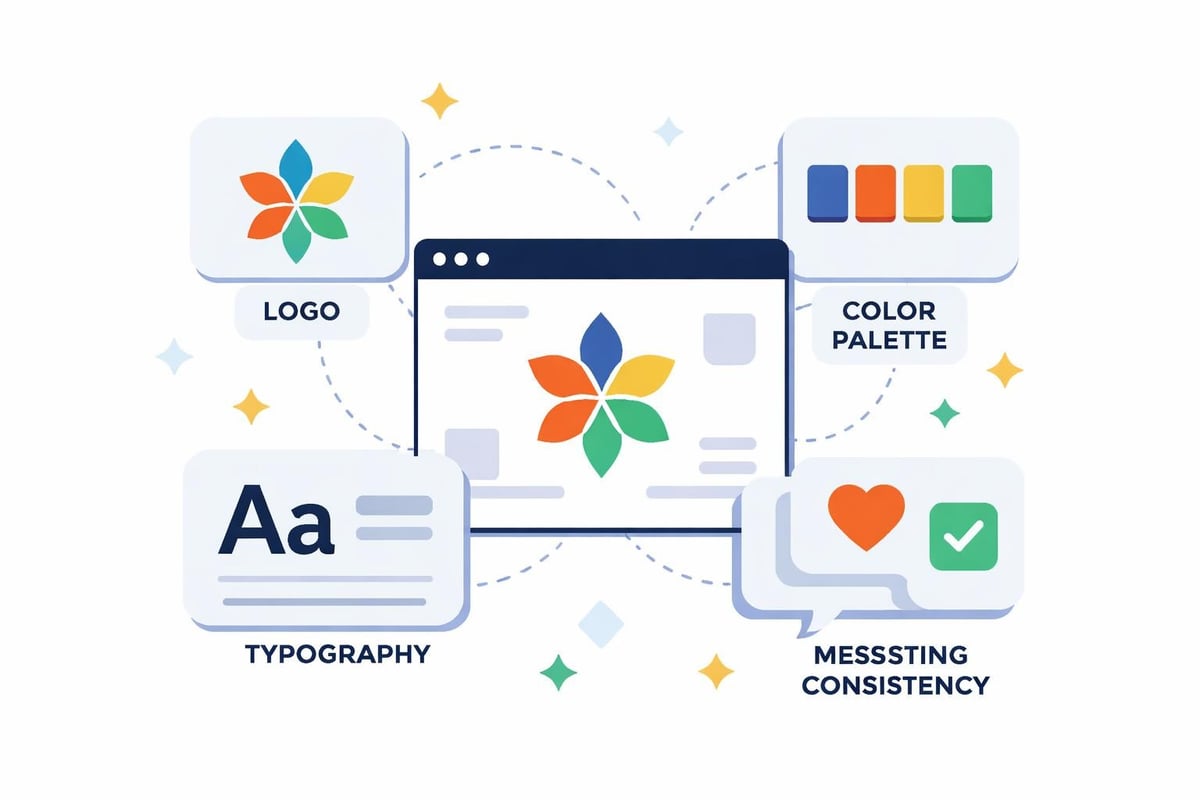
The strategic placement of branding pages within your website architecture also matters significantly. Many businesses create dedicated "About" or "Brand" sections that house their story, team information, and brand guidelines, while others integrate branding elements throughout their entire site experience.
Essential Components That Make Branding Pages Effective
Creating branding pages that truly connect with audiences requires careful attention to specific elements that work together to communicate your identity. These components range from visual design choices to content strategy decisions.
Visual Identity Elements
Your visual brand identity forms the first impression visitors receive. This includes your logo, color palette, typography, imagery style, and overall design aesthetic. Consistency across these elements creates professional credibility and makes your brand instantly recognizable.
| Visual Element | Purpose | Implementation Tip |
|---|---|---|
| Logo | Primary brand identifier | Use consistent sizing and placement rules |
| Color Palette | Evokes emotional responses | Limit to 3-5 primary brand colors |
| Typography | Enhances readability and personality | Choose 2-3 complementary font families |
| Photography Style | Visual storytelling | Maintain consistent tone and composition |
| Graphic Elements | Supporting visual interest | Create reusable design patterns |
The University of Houston's web best practices emphasize maintaining brand standards while prioritizing user experience and accessibility. This balance ensures your branding pages look professional while remaining functional across devices and user contexts.
Content and Messaging Strategy
Beyond visual elements, the words you choose and how you structure information significantly impact how audiences perceive your brand. Your messaging should reflect your brand voice consistently across all branding pages.
Key content components include:
- Clear value propositions that immediately communicate what you offer
- Brand story narratives that humanize your business
- Mission and vision statements that articulate your purpose
- Customer testimonials and social proof that build credibility
- Calls-to-action strategically placed to guide user behavior
When developing branding and web design strategies, content must work in harmony with visual elements. A disconnect between what you say and how you present information creates confusion and undermines trust.
Platform-Specific Branding Page Strategies
Different platforms require tailored approaches to branding pages while maintaining overall consistency. What works on your main website may need adjustment for social media or landing page contexts.
Website Branding Pages
Your website represents your digital headquarters where you maintain complete control over the brand experience. This environment allows for comprehensive storytelling through multiple interconnected pages.
Effective website branding requires consistency in layout patterns, navigation structures, and design systems that create familiarity as users move through your site. Visitors should recognize they're still within your brand ecosystem regardless of which page they're viewing.
Website branding page types:
- Homepage: Your primary brand introduction and navigation hub
- About page: Detailed company history, values, and team information
- Brand guidelines page: Resources for partners, media, and affiliates
- Product/service pages: Branded presentations of your offerings
- Resource centers: Educational content that demonstrates expertise
Stop competing on price when you focus on professional presentation. Services like Branding design visual identities that instantly communicate trust and authority, helping businesses stand out in competitive markets.
Social Media Brand Pages
Social platforms impose structural limitations that require creative adaptation of your brand identity. Despite these constraints, maintaining recognizable branding elements remains crucial for cross-platform consistency.
Looking at exemplary Facebook brand pages reveals how successful companies adapt their branding to social media formats while preserving core identity elements. Profile images, cover photos, post templates, and response patterns all contribute to branded experiences.

Attention Insight's branding tips for landing pages translate well to social branding pages: use brand colors strategically, avoid visual clutter, and incorporate social proof to strengthen credibility.
Optimizing Branding Pages for Search and AI Visibility
Creating beautiful branding pages means little if your target audience never discovers them. Modern optimization requires consideration of both traditional search engines and emerging AI-powered platforms.
Traditional SEO Considerations
Branding pages benefit significantly from search engine optimization that helps potential customers find your business when researching solutions. This includes technical optimization, content strategy, and link building efforts.
Your branding pages should target branded keywords (your company name and variations) as well as category-defining terms that position you within your industry. Proper meta descriptions, title tags, and header structures help search engines understand and categorize your content appropriately.
Understanding how websites appear in Google helps inform optimization strategies that increase visibility for branded searches and related discovery queries.
AI Search Engine Optimization
As AI-powered search platforms like ChatGPT, Claude, Perplexy, and Google's AI Overviews reshape information discovery, branding pages must adapt to remain visible. These systems prioritize authoritative, well-structured information that directly answers user queries.
AI visibility optimization strategies include:
- Structuring content with clear hierarchies and semantic HTML
- Providing comprehensive answers to common industry questions
- Building topical authority through interconnected content clusters
- Implementing schema markup for enhanced understanding
- Maintaining up-to-date, factual information that AI systems trust
The landscape of AI search engines continues evolving rapidly, requiring ongoing adaptation of branding page strategies to maintain visibility across all platforms where potential customers might discover your business.
Measuring Branding Page Performance
Creating effective branding pages requires ongoing measurement and refinement based on actual performance data. Multiple metrics provide insights into how well your pages accomplish their objectives.
Quantitative Metrics
| Metric Category | Key Indicators | What It Measures |
|---|---|---|
| Traffic | Page views, unique visitors, referral sources | Reach and discoverability |
| Engagement | Time on page, scroll depth, interaction rates | Content effectiveness |
| Conversion | Form submissions, clicks, downloads | Business impact |
| Technical | Load speed, mobile usability, error rates | User experience quality |
Analytics platforms like Google Analytics 4 track these metrics comprehensively. Setting up proper GA4 implementation ensures accurate data collection for informed decision-making.
Qualitative Assessment
Numbers only tell part of the story. Qualitative feedback through user testing, surveys, and direct customer interactions reveals how audiences actually perceive and experience your branding pages.
Questions to explore through qualitative research:
- Does your brand identity resonate emotionally with target audiences?
- Are your value propositions clear and compelling?
- Do visual elements create the intended impressions?
- Does your brand voice feel authentic and consistent?
- Are navigation and information architecture intuitive?
Chapman University's branding toolkit emphasizes purposeful development that serves user needs while maintaining brand consistency, a philosophy that requires both quantitative and qualitative evaluation.

Common Mistakes That Undermine Branding Pages
Even well-intentioned branding efforts can fail when certain pitfalls aren't avoided. Recognizing these common mistakes helps businesses create more effective pages from the start.
Inconsistency Across Touchpoints
Perhaps the most damaging mistake involves presenting different versions of your brand across various pages and platforms. When your website uses one color palette, your social media another, and your email marketing yet another, you fragment recognition and confuse audiences.
Consistency requirements:
- Visual elements (logos, colors, fonts) should remain recognizable everywhere
- Messaging tone and vocabulary should feel cohesive across platforms
- Brand promises and value propositions should align completely
- Customer experience quality should meet consistent standards
This doesn't mean every branding page must look identical, but rather that they should feel like part of the same brand family, adapted appropriately for their specific contexts and purposes.
Prioritizing Aesthetics Over Functionality
Beautiful design that frustrates users ultimately fails regardless of how visually impressive it appears. Branding pages must balance aesthetic appeal with practical usability, accessibility, and performance.
Slow-loading pages with stunning visuals lose visitors before making impressions. Complex navigation that confuses users undermines trust. Design choices that ignore accessibility exclude potential customers. The guide to building powerful branding pages emphasizes mobile optimization and clear calls-to-action alongside visual branding.
Neglecting Content Updates
Branding pages that remain static for years communicate that your business has stagnated. While core brand elements should maintain consistency, the content and presentation should evolve as your business grows and market conditions change.
- Review branding pages quarterly for outdated information
- Update team photos, product offerings, and accomplishments regularly
- Refresh design elements periodically to maintain contemporary appeal
- Incorporate new customer testimonials and case studies
- Align messaging with current market positioning
Modern websites built through AI-accelerated web design can launch quickly and adapt easily to changing business needs, ensuring branding pages stay current without requiring complete redesigns.
Integration With Broader Marketing Strategies
Branding pages don't exist in isolation but rather function as components within comprehensive marketing ecosystems. Their effectiveness multiplies when properly integrated with other initiatives.
Content Marketing Alignment
Your branding pages should reflect and reinforce themes explored in your content marketing efforts. Blog posts, guides, videos, and other resources that demonstrate expertise all contribute to brand perception.
When visitors discover your business through educational content and then visit branding pages, they should encounter consistent messaging that reinforces the value you've already demonstrated. This seamless experience builds trust and accelerates relationship development.
Exploring the Creotivity blog reveals how consistent branding across educational content creates cohesive experiences that establish authority while maintaining brand recognition throughout the customer journey.
Conversion Pathway Design
Effective branding pages guide visitors toward meaningful actions:
- Clearly articulated next steps that match visitor intent
- Multiple conversion opportunities at different commitment levels
- Friction-reduced pathways that remove unnecessary obstacles
- Trust signals positioned strategically throughout the journey
- Follow-up mechanisms that continue relationship building
Each branding page should understand its role within broader conversion funnels. Homepage branding establishes awareness, service pages build consideration, and resource pages nurture decision-making processes.
Cross-Channel Promotion
Your branding pages become more powerful when promoted strategically across marketing channels. Email signatures, social media posts, paid advertising, and partnership collaborations should all direct relevant traffic to appropriate branding pages.
This integrated approach requires coordination across teams and platforms, but the compound effect creates significantly greater impact than isolated efforts. When every marketing touchpoint reinforces consistent branding and directs audiences to optimized landing experiences, recognition and conversion rates improve dramatically.
Future-Proofing Your Branding Pages
The digital landscape continues evolving at an accelerating pace, requiring forward-thinking approaches that anticipate change rather than merely reacting to it.
Emerging Technology Considerations
Technologies like voice search, augmented reality, and AI-powered personalization will reshape how audiences interact with branding pages. Preparing for these shifts now positions businesses advantageously as adoption increases.
Semantic markup and structured data become increasingly important as AI systems parse and understand web content. Clear information hierarchies that make sense to both humans and machines ensure visibility across evolving discovery platforms.
Adaptable Design Systems
Rather than creating rigid branding pages that require complete overhauls when needs change, implement flexible design systems that accommodate evolution. Component-based approaches allow updates to specific elements without disrupting entire pages.
Benefits of adaptable systems:
- Faster updates that maintain consistency
- Easier testing of variations and improvements
- Reduced long-term maintenance costs
- Smoother integration of new features
- Better scalability as business grows
This approach acknowledges that branding pages represent living assets requiring ongoing attention rather than one-time projects that remain static indefinitely.
Continuous Learning and Improvement
The most successful branding pages emerge through iterative refinement based on performance data, user feedback, and market changes. Establishing processes for regular review and optimization ensures your pages remain effective over time.
Testing different messaging approaches, visual treatments, and conversion pathways reveals what resonates most powerfully with your specific audiences. These insights then inform broader branding decisions across all marketing efforts, creating compound improvements throughout your digital presence.
Branding pages form the cornerstone of how businesses present themselves in competitive digital environments, creating recognition, trust, and meaningful connections with target audiences. By combining consistent visual identity with strategic messaging, platform-specific optimization, and ongoing refinement, these specialized pages transform casual visitors into loyal advocates. Creotivity helps businesses build comprehensive brand presences through AI-optimized websites, strategic SEO, and professional branding services designed to establish authority and drive measurable results across Google, AI search engines, and every platform where your customers discover solutions.